
Why Most Italian Conversation Practice Doesn’t Work
When learners tell me they want to improve their Italian conversation skills, they usually mean:
- studying more grammar
- memorising vocabulary
- practising predictable “question–answer” sessions with a tutor
But when they finally travel to Italy and try to have a real conversation with an Italian… everything disappears.
They freeze. They blank. They can’t follow the rhythm.
In Italian conversation classes, they hear safe, slow questions like:
“Cosa hai fatto ieri?”
“Ti piace…?”
But real Italians speak fast, with emotion, gestures, and full sentences.
Real conversation is spontaneous and nothing like a textbook.
I’ve been teaching Italian conversation for over 12 years, and I’ve seen thousands of learners stuck exactly here.
That’s why I created a different approach to Italian conversation practice:
learn Italian through stories before the conversation, then use those stories to speak after.
This simple shift transforms everything.
Even Italian beginners can speak more confidently, expand their vocabulary naturally, and actually enjoy conversations when stories prepare their brain.
Why Stories Are the Best Way to Learn Italian Naturally
Stories are one of the fastest ways to improve your Italian speaking. They activate:
Emotion: We remember language that makes us feel something.
Memory: Stories create strong mental connections.I’m always amazed when my students suddenly recall vocabulary they learned two years ago from a simple A2 story.
Context: Words make sense when they appear inside meaningful situations and are connected to an image. Again, I’m amazed when students remember that Costanza — the main character from one of my A1 books — si è persa nel sentiero (she got lost on the trail while hiking in the Italian Alps).
Chunks (not single words, but set phrases “at your level”): This is the key for Italian fluency.
Instead of memorising vocabulary, you absorb natural conversational chunks like:
- A un certo punto…
- Secondo me…
- Mi sono resa conto che…
This is how native speakers think: not in single words, but in ready-made building blocks.
When you read or listen to a story before an Italian conversation class, your brain is already preparing:
- grammar
- vocabulary
- expressions
- real-life scenarios
So spontaneous Italian conversation becomes easier, lighter, more intuitive.

The Advantages of Learning Italian Through Stories
1. You Connect Vocabulary and Grammar Automatically
Stories give you meaning. You learn Italian “in context and imagaes” not through memorisation or drills.
2. Your Listening Skills Improve Fast
Audio stories mirror real Italian rhythm, tone, and melody.
3. You Develop Intuition for Grammar
You see the same structure appear in different situations, so grammar becomes natural instead of abstract.
4. You Get Natural, Varied Repetition
Talking about characters, settings, emotions, and situations from a story naturally makes you:
- conjugate verbs across different subjects
- use multiple tenses
- explore different moods
- step outside the “me, my life, my routine” bubble
Playing with the language is what creates true Italian fluency, not memorising verb tables, lists of unrelated words, or random Duolingo phrases.

My Story-Led Italian Conversation Method (Serena Capilli)
Here is the exact method I use in my Italian conversation classes and coaching:
1. Read a short, level-appropriate Italian story
I choose stories written specifically for adult Italian learners.
2. Listen to the audio
This trains pronunciation, melody, and listening comprehension.
3. Highlight conversational chunks
Useful expressions you can immediately use in real conversations.
4. Prepare to talk about the story
This primes your brain for natural Italian speaking.
In the lesson… we play.
We don’t just review the text. We explore it from every angle:
- talk about the characters
- compare situations
- change details
- personalise the story
- reuse vocabulary in new contexts
- repeat with variation
This blends:
emotional memory + grammar patterns + vocabulary → natural, spontaneous Italian conversation
An Example from My Students
In a story about a woman moving from Rome to Sicily to regain her Italian citizenship, A2 learners learn vocabulary for:
- moving to Italy
- daily life
- bureaucracy
- identity
- culture
Then we use those chunks to talk about:
- moving abroad
- life in Italy
- their own dreams and experiences
- different regions of Italy
The story becomes a conversation generator.
How to Start Using Stories to Improve Your Italian Conversation Skills
If you want better Italian conversations, start simple:
1. Choose a short story at your level
Pick something easy, because the goal is not reading perfection — it’s speaking.
The ideal level?
A story you can read comfortably (around 70% understanding) with just enough challenge to spark new vocabulary but not enough to overwhelm you when talking about it.
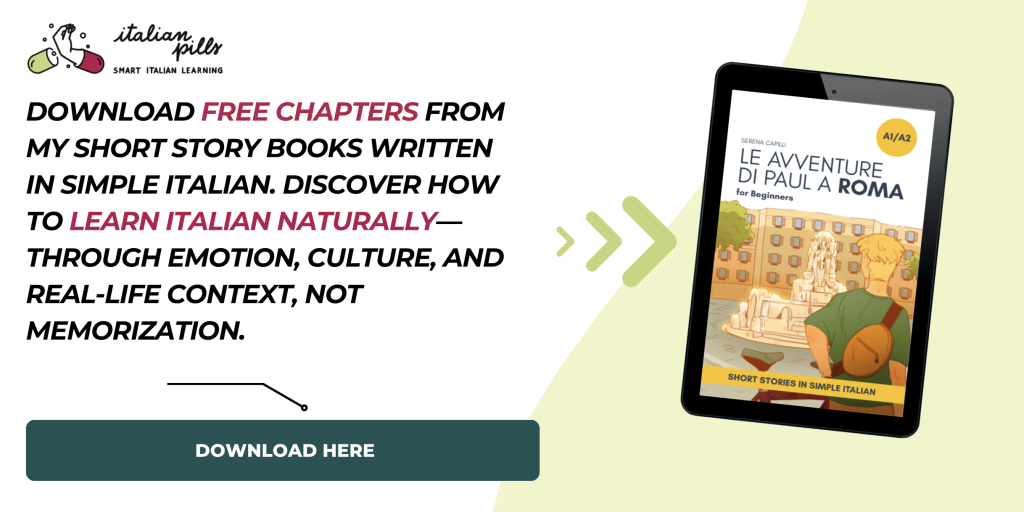
Check out my author page here.
2. Read and listen (again and again)
Find a story with audio + text.
Listening improves comprehension and trains your ear — and good listening skills are vital for real conversations.
Remember: a conversation happens when you listen, understand, and reply, not just when you speak.
3. Shadow useful phrases and chunks
Repeat short phrases out loud to absorb the rhythm, melody, and pronunciation of natural Italian.
This step helps you sound more fluid and less hesitant.
4. Retell the story in simple Italian
Even a tiny retelling — one or two sentences — boosts speaking confidence.
You’re practising vocabulary, grammar, and fluency without forcing anything.
5. Journal about the story
Connect the story to your own life.
Write a few sentences about how the story relates to your experiences or opinions.
This transforms passive input into active, ready-to-use Italian.
And don’t forget to sign up for my newsletter to get invited to my regular group conversation classes all based on my story-led Italian books!
Read more: