Mi serve una penna. Ti servono le chiavi? Le serve altro? If you spend a few days in Italy, you’ll hear servire in every shop, office and kitchen. It’s one of the most useful verbs for everyday life, and it works just like piacere: once you understand one, you understand the other.
In short
- Mi serve = I need, with one thing: Mi serve una forchetta.
- Mi servono = I need, with more things: Mi servono due forchette.
- The thing you need is the subject; you are the indirect object (mi, ti, gli, le…).
- With a name, add a: A Maria serve un passaggio.
- To need to do something, Italians usually say devo or ho bisogno di.
What does mi serve mean?
Mi serve means “I need”. It comes from the verb servire, which works very differently from English “to need”: in Italian, the thing you need is the subject of the sentence, and you are the indirect object. Literally, mi serve una penna means “a pen is useful to me”. That’s why we say mi serve and not io servo.
Mi serve or mi servono?
It all depends on whether the thing you need is singular or plural:
| Form | Used with | Example |
|---|---|---|
| mi serve | one thing (singular) | Mi serve una penna. → I need a pen. |
| mi servono | more things (plural) | Mi servono delle penne. → I need some pens. |
- Ti serve questo documento? → Do you need this document?
- Ti servono questi documenti? → Do you need these documents?
- Ci serve un tavolo più grande. → We need a bigger table.
- Vi servono altre sedie? → Do you all need more chairs?
The present tense of servire
Like piacere, servire is used with indirect object pronouns, and the verb only changes between singular and plural:
| Pronoun | + one thing | + more things | English |
|---|---|---|---|
| mi | serve | servono | I need |
| ti | serve | servono | you need |
| gli / le | serve | servono | he / she needs |
| Le (formal) | serve | servono | you need (formal) |
| ci | serve | servono | we need |
| vi | serve | servono | you all need |
| gli | serve | servono | they need |
Not sure about the pronouns? Here’s my guide to Italian indirect object pronouns.
Why “A Maria serve…” and not “Maria serve…”?
When you name the person who needs something, Italian needs the preposition a, because that person is the indirect object:
- A Maria serve un tappetino da yoga. → Maria needs a yoga mat.
- A Lucia non sono serviti quei documenti. → Lucia didn’t need those documents.
- Ai bambini servono le scarpe nuove. → The kids need new shoes.
It’s exactly the same as mancare (A Patrizia manca l’Italia) and piacere (A Lucia piace l’Italia).
Servire without a pronoun
Sometimes you’ll see serve or servono without a pronoun. In these cases the sentence expresses a general need:
- Non serve altro. → Nothing else is needed.
- Servono dieci minuti. → It takes ten minutes.
- Non serve! → No need!
Mi serve, devo or ho bisogno di?
These three often translate as “I need”, but they are not the same:
| Expression | Used with | Example |
|---|---|---|
| mi serve / mi servono | a thing (noun), often something useful for a purpose | Mi serve il telefono per chiamare Luca. → I need the phone to call Luca. |
| devo | an action (verb): what you have to do | Devo studiare. → I need to study. |
| ho bisogno di | a thing or an action, often more personal | Ho bisogno di una vacanza! → I need a vacation! Ho bisogno di dormire. → I need to sleep. |
And what about mi serve + a verb? In everyday speech you’ll sometimes hear it (Mi serve sapere a che ora arrivi), but as a learner it’s safer to use devo or ho bisogno di with verbs: Ho bisogno di sapere a che ora arrivi.
Servire in the past
In the passato prossimo, servire takes essere, and the participle (servito, servita, serviti, servite) agrees with the thing you needed:
- Mi è servito il tuo consiglio. → Your advice helped me. (I needed your advice.)
- Mi è servita la tua macchina. → I needed your car.
- Ti sono serviti i documenti? → Did you need the documents?
Other tenses of servire
| Tense | + one thing | + more things |
|---|---|---|
| Imperfetto | Mi serviva tempo. → I needed time. | Mi servivano più dettagli. → I needed more details. |
| Futuro | Mi servirà aiuto. → I’ll need some help. | Mi serviranno i tuoi appunti. → I’ll need your notes. |
| Condizionale | Mi servirebbe una mano. → I could use a hand. | Mi servirebbero più informazioni. → I’d need more information. |
Other meanings of servire
Servire is a busy verb. Besides “to need”, you’ll meet it with these meanings:
- to serve: Il cameriere serve il caffè. → The waiter serves the coffee.
- to be useful for, with a: A cosa serve questo? → What is this for?
- in shops: Le serve altro? → Do you need anything else? (Anything else?)
Other verbs like servire
These verbs follow the same structure as piacere and servire:
| Verb | Meaning | Example |
|---|---|---|
| piacere | to like | Mi piace il gelato. → I like ice cream. |
| mancare | to miss, to be missing | Ci mancano i tuoi consigli. → We miss your advice. |
| bastare | to be enough | Non basta il tempo. → There isn’t enough time. |
| interessare | to interest | Mi interessa la storia. → I’m interested in history. |
| sembrare | to seem | Mi sembra un buon film. → It seems like a good movie to me. |
| succedere | to happen | Che cosa ti è successo? → What happened to you? |
See it in a real conversation
Anna and Luca are packing for a weekend in the mountains.
Anna: Che cosa ti serve per il viaggio?
Luca: Mi servono le scarpe da trekking e una giacca calda.
Anna: E la tenda? Ci serve?
Luca: No, non serve, dormiamo in rifugio.
Anna: Perfetto. Allora a me serve solo un buon libro!
Anna: What do you need for the trip?
Luca: I need my hiking boots and a warm jacket.
Anna: And the tent? Do we need it?
Luca: No, no need, we’re sleeping in a mountain hut.
Anna: Perfect. Then all I need is a good book!
Quick practice
Practice with my stories
Speaking of good books: everyday verbs like servire, piacere and mancare come up on almost every page of my graded readers, in real conversations between real-life characters. If you’re at A1 or A2 level, start with one of these:
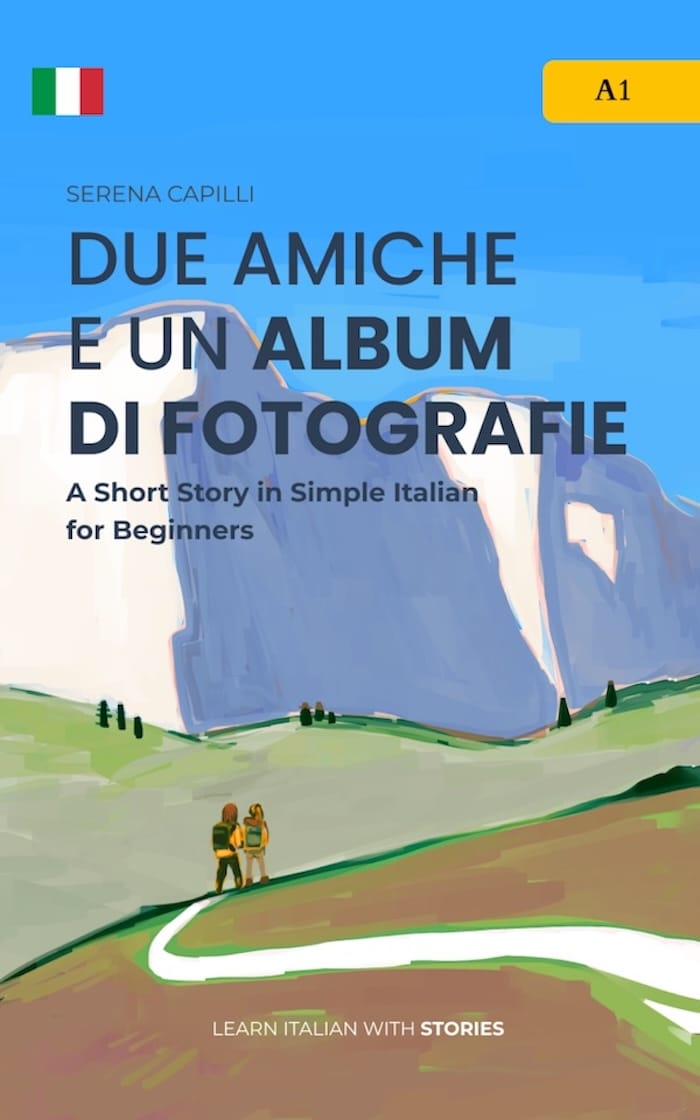
Due Amiche e un Album di Fotografie
Level A1
Two friends, an old photo album and lots of everyday Italian.