Being stuck at B1 in Italian for way too long is frustrating. You can speak, but not confidently enough to hold a detailed conversation. You trip over words, and you’re never quite sure which form is the right one.
Ciao, I’m Serena. I’m a certified Italian teacher (University of Venice), and I’ve been teaching Italian online since 2015. If there’s one sentence I hear more than any other from intermediate students, it’s this: “I understand a lot… but when I speak, nothing comes out.”
This article comes from over ten years of teaching Italian to adult native English speakers, and from what actually helped them break through the infamous intermediate plateau.
The short answer: why you’re stuck at B1
In my experience as a teacher, the intermediate plateau almost always comes from the same few habits: input that is too hard or too easy, learning single words instead of chunks, and practicing skills in separate boxes (reading here, a podcast there, speaking somewhere else).
Fix the quality of your input and organize your routine, and most learners can go from B1 to B2 in roughly 6–12 months with a steady weekly routine.
What the Italian intermediate plateau actually is
As a beginner, you see progress every week. You learn the past tense, then the conditional, and you can feel yourself moving. Then you reach B1 and the curve flattens.
The answer isn’t to study more grammar. That’s the most common mistake I see students make (and teachers too). What you need is a method that brings together everything you’ve already learned about grammar and vocabulary.
If you want to stop translating word for word and using the same three verbs and sentences, start by checking these five habits.
Five reasons you’re stuck at B1
1. Your input is in the wrong zone
Many learners jump to native content too early: TV series, Italian YouTube, podcasts for native speakers. Others stay forever with beginner apps. Both are a trap.
My rule of thumb: you need material you can understand about 70–80% of. This is called comprehensible input. You understand most of it and can figure out the rest from context. In my view, native content becomes truly useful around B2–C1. Before that, graded content (graded readers, learner magazines, accessible podcasts about real topics) does much more work for you.
My tip: spend some time finding the right content for your level, then stick with it.
2. You’re still collecting individual words
One of my golden rules: learn in chunks, not isolated words. At B1 you probably know the word geniale. But do you automatically say ho avuto un’idea geniale? Do you know avere un’idea geniale as a block, ready to use?
Fluency isn’t about knowing more words. It’s about having more ready-made pieces, and the brain remembers phrases much better than isolated words. I talk about this in Episode 12 of my podcast, “Il segreto per imparare il vocabolario italiano”.
3. Your skills live in separate boxes
You read one thing, listen to something unrelated, then do “conversation practice” on a random topic with a tutor. This is exactly what creates the plateau: nothing gets recycled, so nothing sticks.
The secret is to read, listen and speak about the same content. That’s how fluency is built.
4. Conversation practice without content
This may surprise you, coming from a teacher who also teaches conversation: I don’t think casual speaking alone gets you past B1. If every lesson is “So, what did you do this weekend?”, you keep using the 300 words you already feel safe with. You get more comfortable, not more advanced.
5. Passive listening in the background
Italian radio while you cook feels productive, but if you barely understand it, it isn’t doing much. Five focused minutes do more than sixty minutes of a podcast you can’t follow.
Active listening (listen, read along, listen again) is what trains your ear. There’s a full method in my guide on how to improve your Italian listening.
How to go from B1 to B2 with chunks, not grammar
When I listen to intermediate learners, the jump from B1 to B2 is often less about new grammar and more about a handful of small “glue” phrases. English-speaking learners in particular tend to build sentences with e… e poi… e poi…, because that’s the safe structure.
Here are three chunks that change how you sound:
- Mi sembra che… (It seems to me that… / I think…). Mi sembra che sia una buona idea. A bonus: it brings the congiuntivo into your speech naturally.
- Ho avuto un imprevisto (Something came up). Scusa il ritardo, ho avuto un imprevisto.
- Mi è sfuggito (I missed it / It slipped my mind). Scusa, mi è sfuggito il tuo messaggio.
This is how I like my students to learn Italian at an intermediate level: ready-to-use sentences they come across in context, then study and reuse.
A simple method to get unstuck
Here’s the structure I recommend. It’s not glamorous, but it works because it connects everything. Quality matters more than hours, and consistency matters more than intensity.
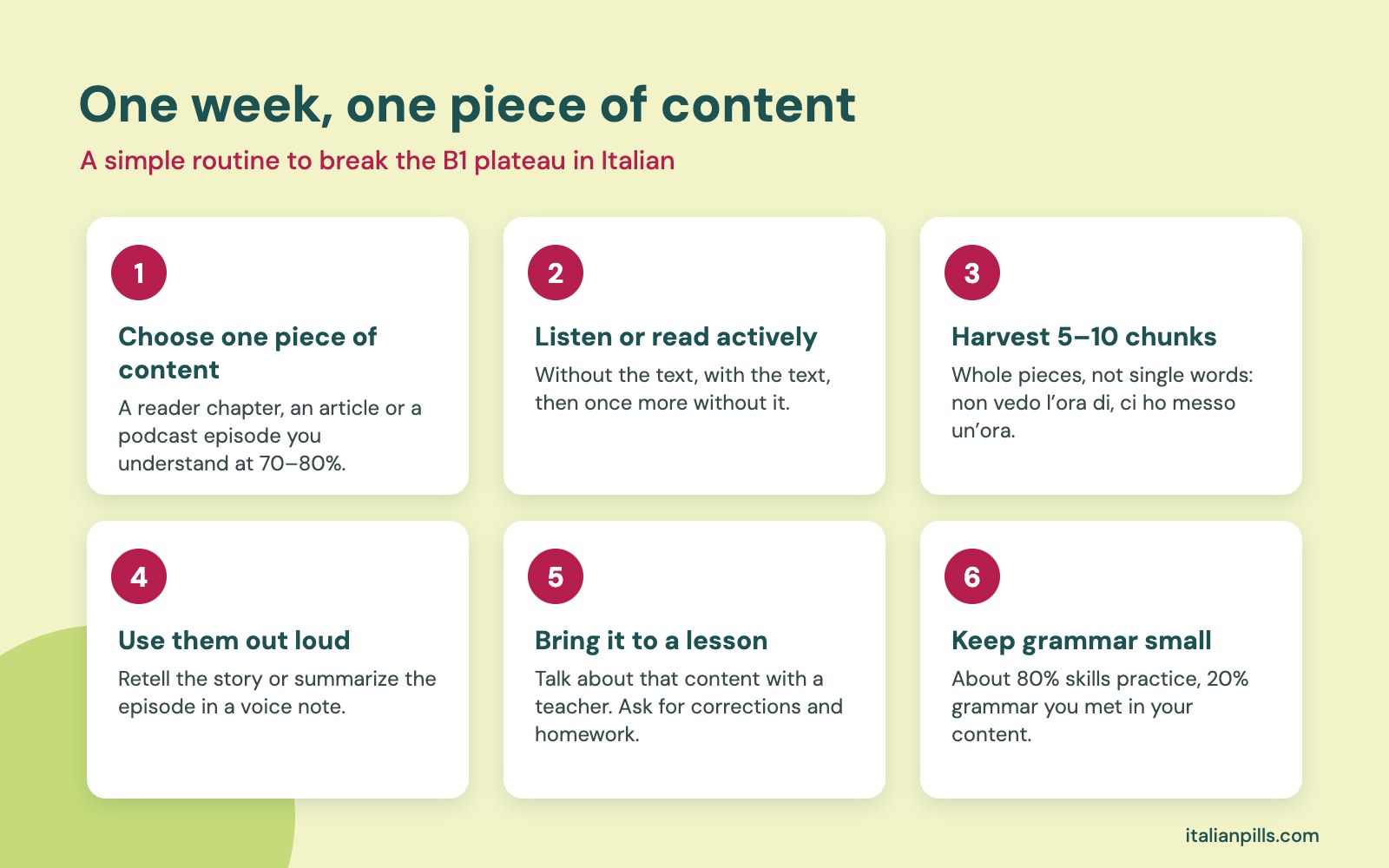
- Choose one piece of content for the week. A chapter of a graded reader, one magazine article or one podcast episode at your level (around 70–80% understandable).
- Listen actively: first without the transcript, then while reading it, and finally once more without it.
- Harvest 5–10 chunks. Not single words: whole pieces like non vedo l’ora di, ci ho messo un’ora, mi sono reso conto che.
- Use them out loud. Retell the story or summarize the episode, on your own or in a voice note, using those chunks.
- Bring it to a lesson. Talk with a teacher about that content, not about the weather. Ask to be corrected and to get homework.
- Keep grammar small. Roughly 80% skills-based practice and 20% grammar review, focusing on the grammar you actually encounter in your content.
In terms of time, one hour a week with a teacher or a structured class, plus two or three hours of self-study, is enough for most of my students to feel the difference. A focused 2–3-month listening and reading phase can transform your Italian more than a year of scattered study.
My personal recommendation
If I had to give you one thing to do starting tomorrow: stop adding new resources and go deeper into fewer ones. At B1, graded readers are, in my opinion, the most effective tool available, because a story gives you context, emotion and repetition at the same time.
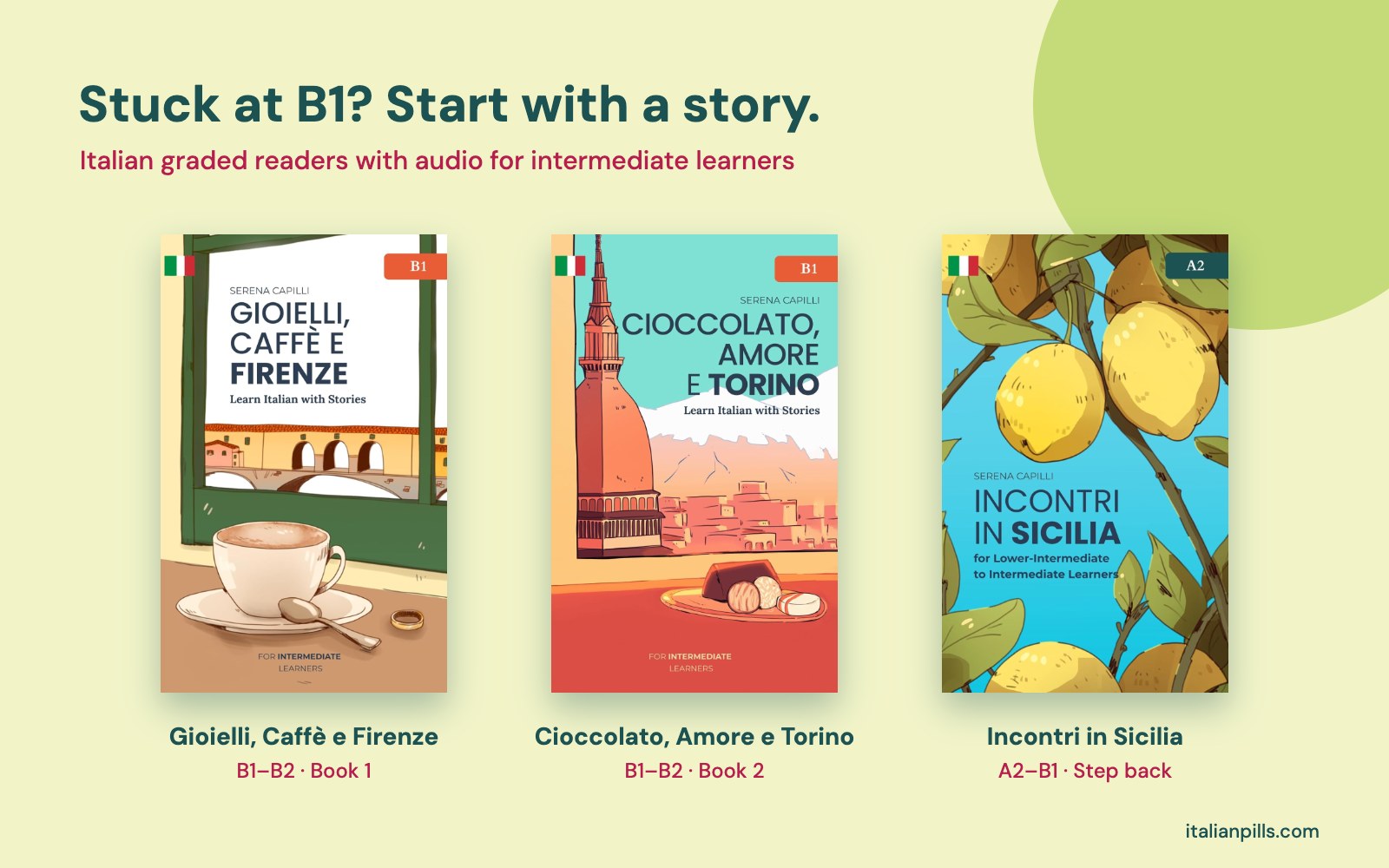
For learners stuck right at B1, I’d start with Gioielli, Caffè e Firenze (B1–B2, set in Florence, Book 1 of Le città di Marie), then continue with Cioccolato, Amore e Torino (Book 2).
If B1 still feels heavy, step back to Incontri in Sicilia (A2–B1). Going one step down for a few weeks is not a failure. It’s how you rebuild momentum.
For listening, my free podcast Piazzetta Italiana is slow Italian about modern Italy, with transcripts and worksheets built around chunks. Episode 14 is specifically about improving your spoken Italian.
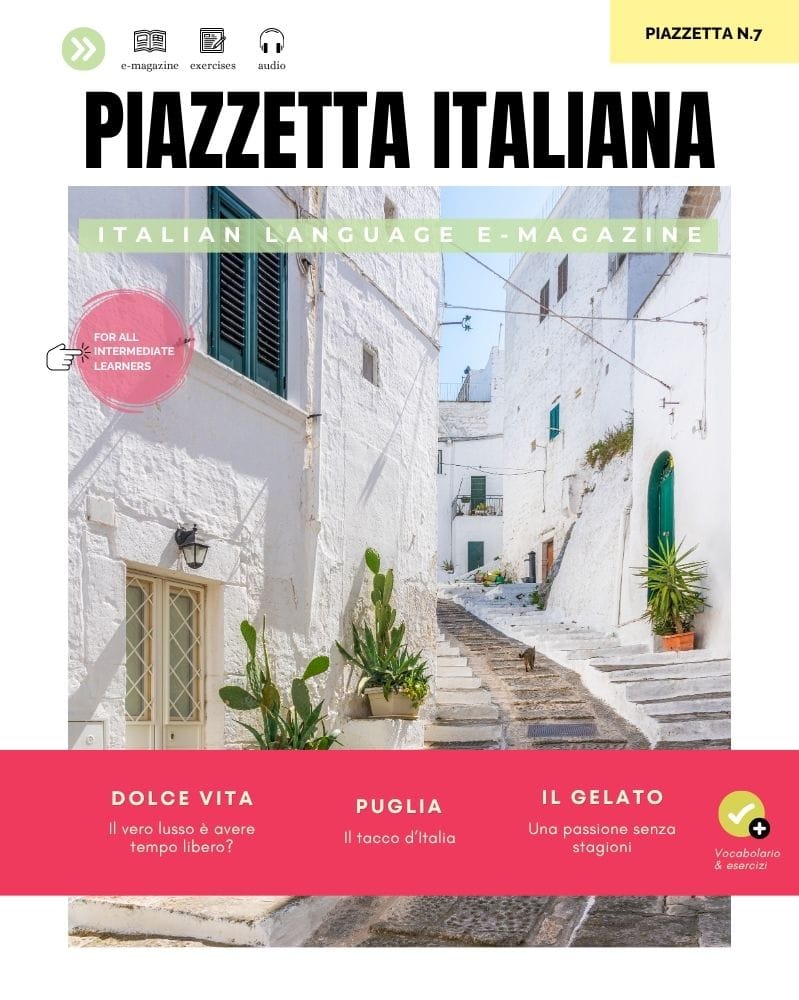
And if you want real Italian lifestyle content at your level, the Piazzetta Italiana magazine is designed for intermediate learners who are ready for “real” topics but not yet for native newspapers.
Ready to get unstuck with a story? My Italian graded readers come with vocabulary support, exercises and audio. Pick one at your level and start collecting the chunks you want to use. Explore Italian graded readers with audio →
Want a teacher to help you through the plateau?
Self-study with good input takes you far, but a teacher who corrects you and builds lessons around what you read and listen to can speed things up a lot.
If you don’t have one yet, Preply is an easy way to find an Italian tutor who fits your schedule and budget. My tip: choose a tutor who corrects your mistakes and gives you homework, not just casual chat.
Ready to practice with a teacher? Find a native Italian tutor who fits your level and schedule: find your Italian tutor on Preply →
Affiliate link. If you book a lesson, I may earn a small commission at no extra cost to you.
FAQ
Why am I stuck at B1 in Italian?
Usually because of your routine, not your talent. The most common causes are input that’s too hard or too easy, learning single words instead of chunks, and practicing reading, listening and speaking on unrelated content.
How long does it take to go from B1 to B2 in Italian?
With a steady weekly routine, most learners need roughly 6–12 months. One hour a week with a teacher plus two or three hours of focused self-study is enough to feel the difference.
Should I study more grammar to reach B2?
Not much more. At B1 the jump comes from using what you already know. I suggest about 80% skills-based practice and 20% grammar review, focused on the grammar you meet in your reading and listening.
Is watching Italian TV series enough to reach B2?
Not on its own. Native content works best from around B2–C1. Before that, choose material you can understand about 70–80% of, like graded readers, learner magazines and slow Italian podcasts.
What are chunks in Italian?
Chunks are ready-made groups of words you learn as one block, like ho avuto un imprevisto or mi sembra che. They help you speak faster and sound more natural than building every sentence word by word.