Mi dispiace and scusa both translate as “I’m sorry,” and that’s exactly why they confuse English speakers. In Italian they’re not interchangeable: they express different things and, above all, different emotions.
In short
- Mi dispiace = I’m sorry, I feel bad about it. For sympathy, regret, bad news: Mi dispiace per tuo nonno.
- Scusa (tu) / scusi (Lei) = sorry, excuse me. For small mistakes, interruptions and getting someone’s attention: Scusi, dov’è il bagno?
- When you apologize for something you did, both work: Scusa il ritardo or Mi dispiace per il ritardo.
- Ti dispiace…? means something else: “Do you mind…?”
Mi dispiace: I’m sorry (from the heart)
When you say mi dispiace, you’re expressing sympathy, regret or disappointment. Literally, it means “it displeases me.” If you imagine a gentle hand on someone’s shoulder, that’s mi dispiace.
Use mi dispiace when:
- someone tells you something sad
- you want to show empathy
- you feel genuinely sorry about a situation, even if it’s not your fault
- you have to say no to something
| Italian | English |
|---|---|
| Mi dispiace per tuo nonno. | I’m sorry about your grandfather. |
| Mi dispiace, non posso venire. | I’m sorry, I can’t come. |
| Mi dispiace tanto! | I’m so sorry! |
| Mi dispiace per il ritardo. | I’m sorry for being late. |
Scusa / scusi: sorry, excuse me
Scusa (informal, tu) and scusi (formal, Lei) are for quick, practical, everyday apologies. The tone is light, not emotional.
Use scusa / scusi when:
- you bump into someone
- you interrupt
- you make a small mistake
- you need someone’s attention, like “excuse me” in English
| Italian | English |
|---|---|
| Scusa, puoi ripetere? | Sorry, could you say that again? |
| Scusi, dov’è il bagno? | Excuse me, where’s the restroom? |
| Ops, scusa! | Oops, sorry! |
| Scusa il ritardo! | Sorry I’m late! |
All the ways to say sorry in Italian
| Expression | When | Register |
|---|---|---|
| scusa / scusami | to one person you call tu | informal |
| scusi / mi scusi | to one person you call Lei | formal |
| scusate | to two or more people | informal or formal |
| chiedo scusa | “I apologize,” a bit more serious | neutral, formal |
| mi dispiace (tanto / molto) | sympathy and regret | neutral |
| perdonami / mi perdoni | “forgive me,” for something more serious | emotional |
| permesso | “excuse me,” when you need to get past someone or enter a room | polite |
Ti dispiace…? Do you mind…?
With a question, dispiacere changes meaning: Ti dispiace…? / Le dispiace…? = “Do you mind…?”
- Ti dispiace chiudere la finestra? (Do you mind closing the window?)
- Le dispiace se mi siedo qui? (Do you mind if I sit here?)
Careful with the answer: No, figurati! means “No, not at all, go ahead!”
Why it’s confusing for English speakers
In English, “sorry” does all the work. In Italian, choosing the right word shows that you understand both the situation and the emotion. A simple way to remember:
- A small slip or getting attention → scusa / scusi
- Sadness, bad news or disappointment → mi dispiace
Common mistakes
| Situation | ❌ Not this | ✅ But this |
|---|---|---|
| A friend tells you her cat died. | Scusa. | Mi dispiace tanto. |
| You didn’t hear what someone said. | Mi dispiace, puoi ripetere? | Scusa, puoi ripetere? |
| You want to ask a stranger for directions. | Mi dispiace, dov’è la stazione? | Scusi, dov’è la stazione? |
| You make a small grammar mistake while speaking. | Mi dispiace tantissimo! | Scusa! (or just correct yourself) |
Exercise: mi dispiace or scusa/scusi?
- ______, signora, sa che ore sono?
- Hai perso il lavoro? ______ tanto.
- Ops, ti ho pestato il piede! ______!
- ______, non posso venire alla tua festa: sono fuori città.
- ______, posso passare?
Show the answers
- Scusi
- Mi dispiace
- Scusa
- Mi dispiace
- Permesso / Scusi
Frequently asked questions
What is the difference between mi dispiace and scusa?
Mi dispiace expresses sympathy or regret (“I’m sorry, I feel bad about it”). Scusa is a quick, practical apology or a way to get someone’s attention (“sorry,” “excuse me”).
What is the difference between scusa and scusi?
Scusa is informal (for people you call tu), scusi is formal (for people you call Lei). Use scusate with two or more people.
How do you say “I’m sorry for your loss” in Italian?
Mi dispiace molto, or more formally Le mie condoglianze.
What does “ti dispiace” mean?
In a question, ti dispiace…? means “do you mind…?”: Ti dispiace chiudere la finestra?
Practice with my stories
In my stories, characters apologize, interrupt and comfort each other all the time: the best way to hear mi dispiace and scusa in context. Here are three to try:
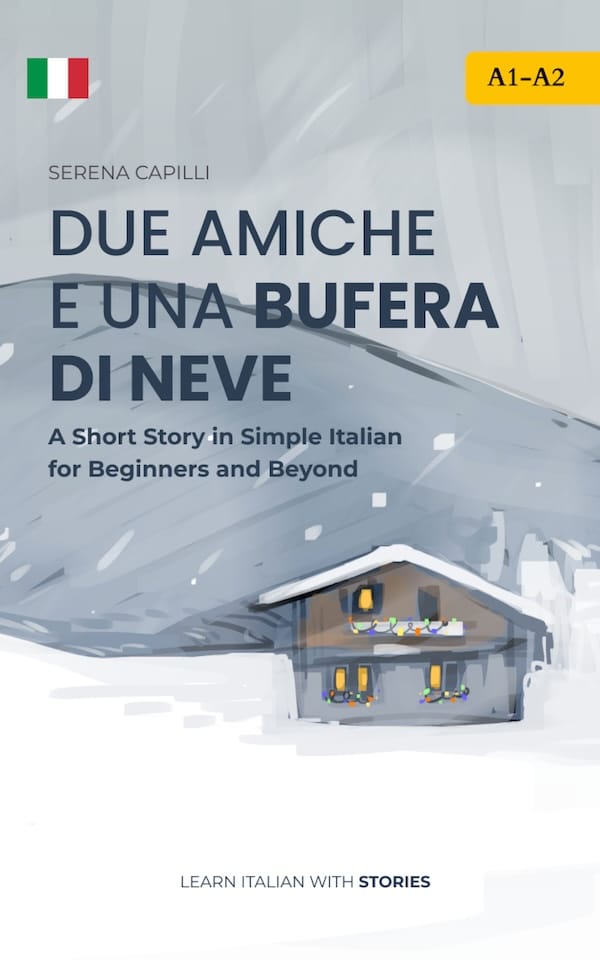
Due Amiche e una Bufera di Neve
Level A1/A2
Costanza and Anna get stuck in a snowstorm, with a surprise.
Read more: Best Italian short stories for beginners · Best Italian short stories for intermediate learners