How simple Italian stories help beginners and intermediate learners build vocabulary, confidence, and real conversation skills
If you have ever tried to improve your Italian conversation skills, you probably know this frustrating feeling: you study grammar, memorize vocabulary, and complete exercises—but when someone asks you an unexpected question, your mind goes blank and putting a sentence together feels like a struggle.
I started teaching Italian online in 2015, back when most of my lessons still took place on Skype. For years, my beginner and intermediate conversation classes ran into the same problem.
The problem was not my students. It was the whole idea of what a “conversation class” was supposed to be.
Why free conversation often fails beginners—and not only beginners
Here is what usually happens.
You put a beginner or intermediate learner in a conversation class and ask them to converse.
“So, what did you do this weekend?”
They can often answer that question because they have practiced it many times. But as soon as the conversation moves to an unfamiliar topic, they freeze.
Not because they are shy. Not because they have not studied.
They freeze because they do not have enough words yet—or enough confidence to put those words together quickly.
Asking a beginner, or even a lower-intermediate learner, to maintain a completely free conversation is like asking someone to run before they can stand. There is nothing for them to hold on to.
Why authentic Italian can be too difficult
Teachers often try to solve this problem by introducing “real Italian”: a newspaper article, a film clip, a song, or a podcast made for native speakers.
The material is authentic, but now the problem flips.
Native content is created for native speakers. A single sentence may contain several unfamiliar words, an idiom, and a verb tense the learner has never studied.
Instead of feeling challenged, the learner feels lost.
Textbooks offer another option, but they often contain only a small number of units built around predictable dialogues. The language may be accessible, but the subject matter rarely gives learners something they genuinely want to discuss.
For a long time, I felt stuck between three unsatisfying choices:
- empty conversations;
- overwhelming native content;
- lifeless textbook dialogues.
The lessons felt productive, but my students were not making the progress I wanted them to make.
Then I realized they needed a fourth option.
The missing ingredient: a story they could understand
My students needed something meaningful to talk about before they were asked to speak.
They needed Italian input that was digestible and enjoyable: short texts written with simple grammar, high-frequency vocabulary, and a clear storyline.
Most importantly, they needed content they could understand well enough to use.
When students understand a story, they can summarize what happened. They can describe a character, predict what will happen next, express an opinion, or explain what they would have done differently.
And because they have already encountered the relevant vocabulary while reading, they have the words they need to talk about it.
This is where something powerful happens: learners begin using what they have just understood.
Reading a story and then speaking about it helps turn passive knowledge into active language. The words are still fresh, the context is clear, and the learner is not starting from nothing.
Suddenly, there is no uncomfortable silence.
The story gives them something to hold on to.
So I started writing short Italian stories for my classes. The language was simple, but they were still real stories—set in places I loved, with characters who felt alive and situations worth discussing.
We built the entire lesson around them.
The story introduced vocabulary and grammar in context. It also provided the ideas, characters, and conflicts we needed for a real conversation.
My beginner and intermediate students were speaking Italian. They were using simple words, but they were communicating—and enjoying it.
How one short story becomes a full Italian lesson
The stories also helped me give every class a clear structure.
Before the lesson, students would read and listen to a short chapter of around 200 to 300 words. It was enough to introduce useful language without becoming overwhelming.
During the lesson, we would:
- summarize the chapter as a warm-up;
- describe the characters and setting;
- discuss the main situation or theme;
- create new sentences using vocabulary from the story;
- role-play a scene or invent a different ending.
A single short chapter gave us enough material for an entire conversation lesson.
Students no longer had to invent a topic and find the right Italian words at the same time. The story had already given them the context and much of the language they needed.
You can use the same method independently: read, listen, summarize, and then discuss the story with a tutor, a language partner, or even out loud by yourself.
How my Italian graded readers began
One day, after a lesson based on one of these stories, a student said:
“You should write these down. You should publish them.”
So I did.
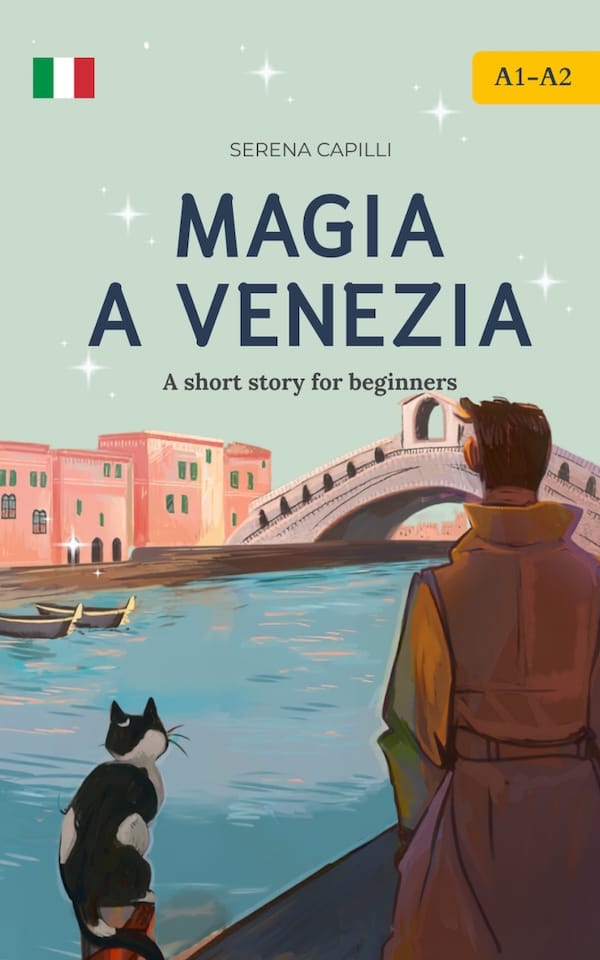
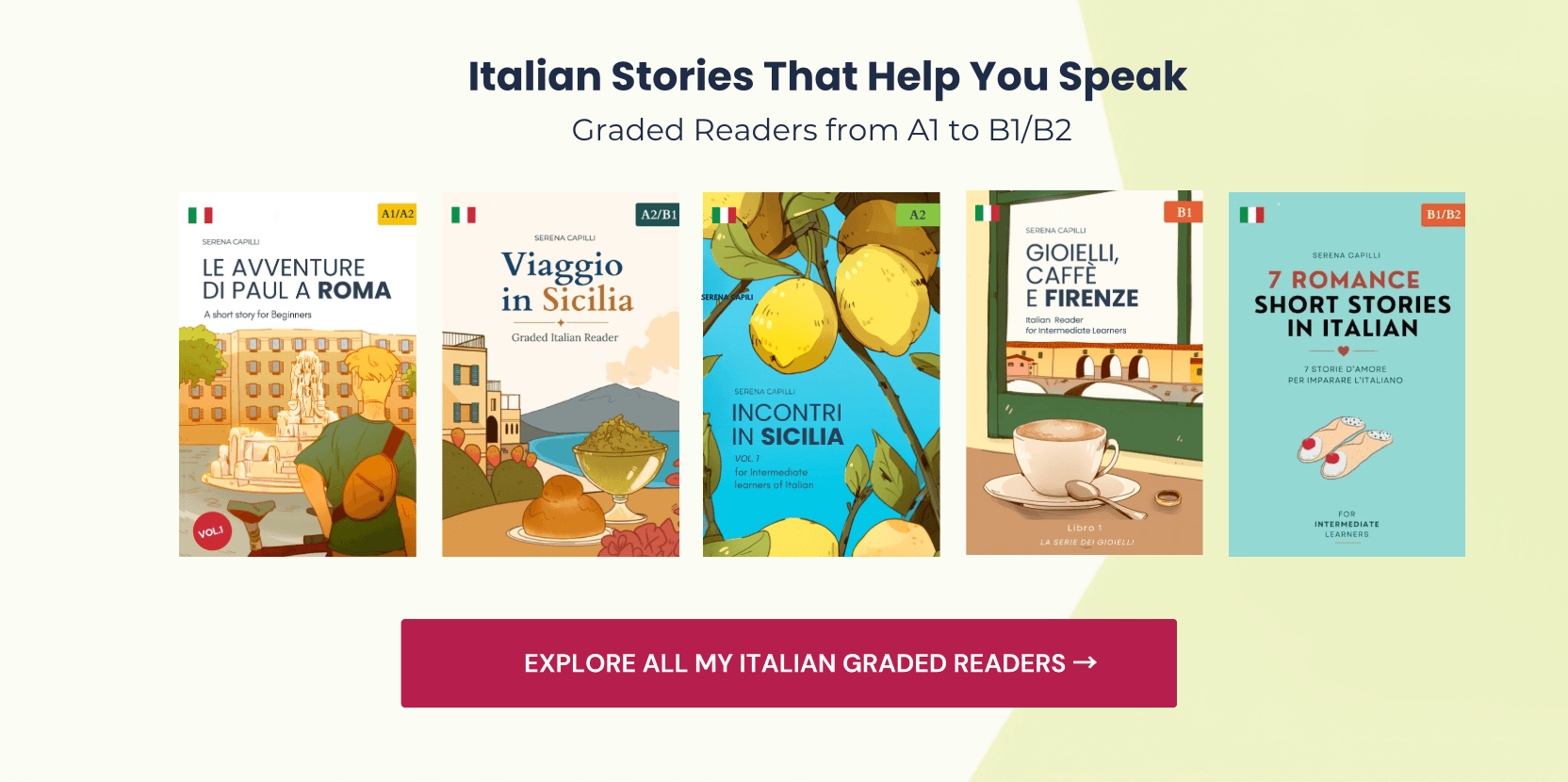
That is where my Italian graded readers came from.
Each reader began as material for a real conversation lesson: a story simple enough for an Italian learner to understand, but rich enough to inspire questions, opinions, and discussion.
The stories are organized by CEFR level, from complete beginner at A1 to intermediate at B1–B2. Each one is set in a different corner of Italy and designed to be read for pleasure—not treated like another grammar exercise.
They help learners encounter useful vocabulary repeatedly, notice grammar in context, and develop the confidence to talk about what they have understood.
Explore the Italian graded readers by level →
From reading Italian to listening to it
Reading is only half of the process. Learners also need regular Italian listening practice.
But native audio creates the same difficulty as native text. Podcasts and videos spoken at a natural speed can leave beginners behind within the first thirty seconds.
That is why I created Piazzetta Italiana, my slow Italian podcast.
The episodes follow the same principle as the books: clear, comprehensible Italian about real places, everyday experiences, and Italian culture.
The language is spoken slowly and clearly—not because learners should listen to simplified Italian forever, but because they first need audio they can actually follow.
Like the graded readers, every episode can become the starting point for a conversation. You listen, understand the main ideas, and then use them to summarize, react, ask questions, or share your own experience.
It is the same method, delivered through your ears instead of on the page.
Listen to the free Piazzetta Italiana slow Italian podcast →
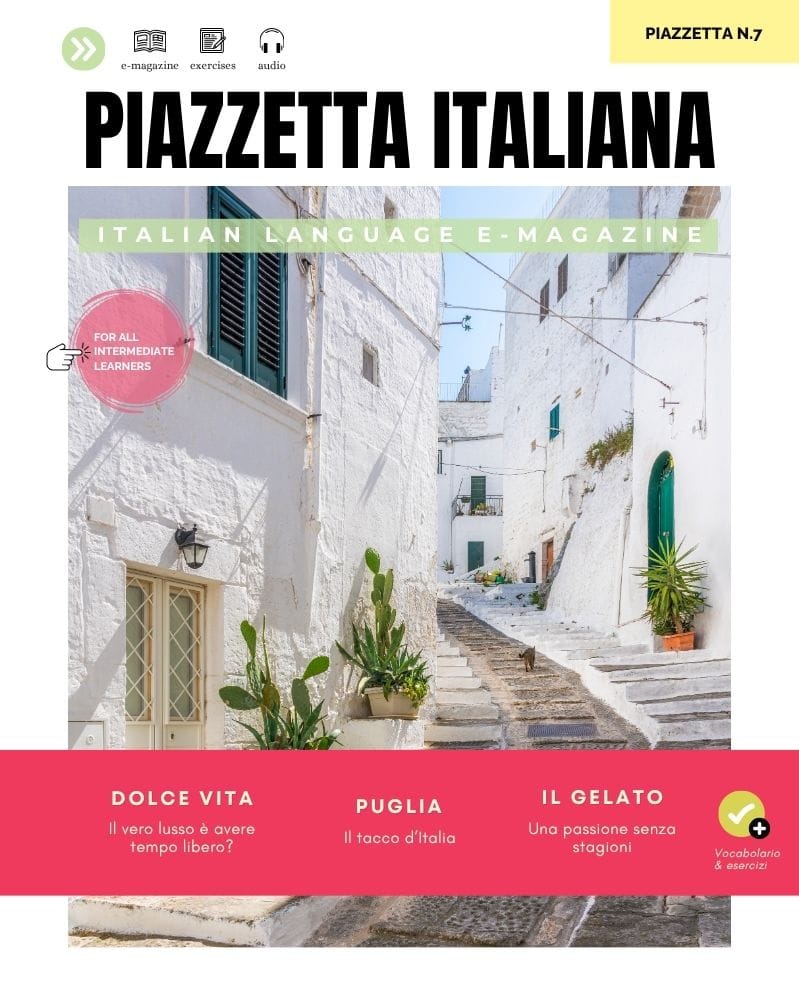
More comprehensible Italian through the magazine
I created Piazzetta Italiana Magazine for the same reason.
Learners need regular contact with Italian, but they also need variety. The magazine offers accessible content for learners from A2 to B2, with topics connected to Italian life, culture, places, and language.
It gives you something new to read, understand, and talk about—without having to struggle through material written exclusively for native speakers.
Browse Piazzetta Italiana Magazine from A2 to B2 → HERE
The idea behind everything I create
There is one idea connecting my graded readers, podcast, magazine, and learning materials:
You cannot speak a language from nothing.
You need input you can genuinely understand—and it needs to be about something worth understanding.
Give learners accessible Italian, interesting characters, and a meaningful situation, and they finally have something to say.
Grammar still matters. Grammar is the map.
But the story is the journey—and the journey is what makes you want to keep going.
Start learning Italian through stories and comprehensible input
Choose the format that works best for you.
Browse Italian graded readers from A1 to B2 →
Find a story appropriate for your current level and begin reading Italian without stopping every few words.
More info on my graded readers HERE
Listen to Piazzetta Italiana →
Practice understanding slow, clear Italian while discovering Italian places, culture, and everyday life.
Browse Piazzetta Italiana Magazine from A2 to B2 → LINK
Build a regular Italian reading habit with accessible content created for language learners.