Verbs ending in -ire are the third and smallest group of Italian verbs, but they include some you’ll use every single day: dormire, sentire, partire, capire, finire, preferire. The only tricky part is that they come in two “flavors”. Once you can tell them apart, conjugating them is easy.
In short
- There are two types of -ire verbs: verbs like dormire (io dormo) and verbs like capire (io capisco).
- Verbs like capire add -isc- in all forms except noi and voi.
- You can’t tell the type from the infinitive: learn each verb with its io form.
- A few common -ire verbs are truly irregular: venire, uscire, dire, salire, morire.
Type 1 and type 2: dormire vs capire
Here are the two patterns side by side, in the present tense. The endings are the same, the only difference is the -isc- in four forms:
| Pronoun | dormire (to sleep) | capire (to understand) |
|---|---|---|
| io | dormo | capisco |
| tu | dormi | capisci |
| lui / lei | dorme | capisce |
| noi | dormiamo | capiamo |
| voi | dormite | capite |
| loro | dormono | capiscono |
Both patterns are regular: capire is not “irregular”, it just follows the second model. The -isc- is pronounced -isk- before -o and -ono (capisco, capiscono) and -ish- before -i and -e (capisci, capisce).
Common -ire verbs like dormire
| Verb | English | Example |
|---|---|---|
| dormire | to sleep | Dormo otto ore a notte. → I sleep eight hours a night. |
| sentire | to hear, to feel | Senti la musica? → Can you hear the music? |
| partire | to leave, to depart | Il treno parte alle nove. → The train leaves at nine. |
| aprire | to open | Apro la finestra. → I’ll open the window. |
| offrire | to offer | Offro io! → It’s on me! |
| seguire | to follow | Seguo un corso di italiano. → I’m taking an Italian course. |
| coprire | to cover | Copri la pentola. → Cover the pot. |
| scoprire | to discover, to find out | Scopriamo Roma insieme! → Let’s discover Rome together! |
| vestirsi | to get dressed | Mi vesto in cinque minuti. → I get dressed in five minutes. |
Common -ire verbs with -isc-, like capire
| Verb | English | Example |
|---|---|---|
| capire | to understand | Non capisco. → I don’t understand. |
| finire | to finish | A che ora finisci? → What time do you finish? |
| preferire | to prefer | Preferisco il tè. → I prefer tea. |
| pulire | to clean | Pulisco la cucina. → I’m cleaning the kitchen. |
| spedire | to send, to ship | Spedisco il pacco oggi. → I’m sending the package today. |
| restituire | to give back | Ti restituisco il libro domani. → I’ll give you the book back tomorrow. |
| suggerire | to suggest | Che cosa mi suggerisci? → What do you suggest? |
| costruire | to build | Costruiscono una casa. → They’re building a house. |
| dimagrire | to lose weight | In estate dimagrisco sempre. → I always lose weight in summer. |
How do I know which type a verb is?
Unfortunately, you can’t tell from the infinitive: partire and finire look exactly the same, but we say parto and finisco. My advice is to learn each new -ire verb together with its io form, like a little pair: dormire, dormo / capire, capisco. Good dictionaries always show it.
Truly irregular -ire verbs
A few very common -ire verbs don’t follow either pattern. These are the ones worth learning by heart:
| Verb | io | tu | lui / lei | noi | voi | loro |
|---|---|---|---|---|---|---|
| venire (to come) | vengo | vieni | viene | veniamo | venite | vengono |
| uscire (to go out) | esco | esci | esce | usciamo | uscite | escono |
| dire (to say) | dico | dici | dice | diciamo | dite | dicono |
| salire (to go up) | salgo | sali | sale | saliamo | salite | salgono |
| morire (to die) | muoio | muori | muore | moriamo | morite | muoiono |
See them in a real conversation
Giulia: Stasera esci con noi?
Marco: Non so, finisco di lavorare tardi.
Giulia: Dai, vieni! Apriamo una bottiglia di vino e sentiamo un po’ di musica.
Marco: Mmm… preferisco restare a casa. Sono stanco e dormo poco in questi giorni.
Giulia: Capisco. Allora domani offri tu il caffè!
Giulia: Are you going out with us tonight?
Marco: I don’t know, I finish work late.
Giulia: Come on, come! We’ll open a bottle of wine and listen to some music.
Marco: Hmm… I’d rather stay home. I’m tired and I’m not sleeping much these days.
Giulia: I understand. Then tomorrow the coffee is on you!
Practice with my stories
Verbs like capire, preferire and uscire are everywhere in everyday conversations, and that’s exactly what my graded readers are made of. Reading them in context is the easiest way to make these forms automatic. If you’re a beginner, start with one of these:
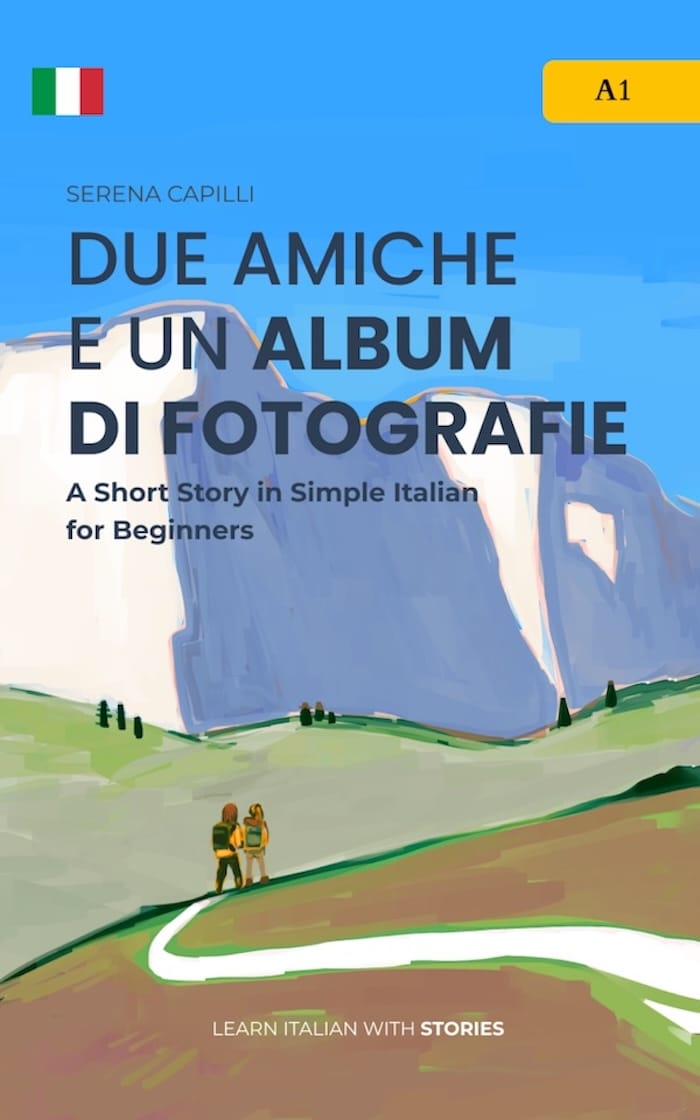
Due Amiche e un Album di Fotografie
Level A1
Two friends, an old photo album and lots of everyday Italian.