Senti! Guarda! Dai, vieni! Spend a day in Italy and you’ll hear the imperative everywhere: at the market, in the kitchen, on the phone, between friends. Many of my English-speaking students are afraid it sounds rude, so they avoid it. Good news: in Italian, the imperative is normal, friendly and everyday. Let’s see how it works, step by step.
In short
- The imperative is for telling people what to do: orders, advice, invitations, directions.
- It has four forms: tu (informal), voi (you all), noi (let’s) and Lei (formal).
- Tu: parla! (-are verbs end in -a), prendi! apri! (-ere/-ire end in -i).
- Negative tu: non + infinitive: non parlare!
- Pronouns: attached at the end with tu, voi, noi (guardami!), before the verb with Lei (mi guardi!).
What is the imperative in Italian?
We use the imperative (l’imperativo) to:
- tell people to do something: Chiudi la porta!
- give advice: Prova questo gelato!
- invite someone: Vieni a cena da noi!
- give directions: Gira a destra e vai dritto.
Since it’s about telling someone what to do, it only exists for the people you can talk to: tu, voi, Lei and noi (which means “let’s”).
The imperative at a glance
Here are the four regular forms of the imperative. If you remember just one table, make it this one:
| parlare | prendere | aprire | finire | |
|---|---|---|---|---|
| tu | parla! | prendi! | apri! | finisci! |
| noi | parliamo! | prendiamo! | apriamo! | finiamo! |
| voi | parlate! | prendete! | aprite! | finite! |
| Lei (formal) | parli! | prenda! | apra! | finisca! |
Notice that most forms are the same as the present tense. The only surprises are the tu form of -are verbs (parla, not parli) and the Lei form, which comes from the subjunctive.
The informal imperative: tu, voi, noi
This is the imperative you’ll use with friends, family, children and anyone you call tu.
- Tu: -are verbs end in -a (mangia!), -ere and -ire verbs end in -i (prendi! dormi!). Verbs like finire keep the -isc-: finisci!
- Voi: the same as the present tense: mangiate! prendete! dormite!
- Noi: the same as the present tense, and it means “let’s”: mangiamo! andiamo!
| Italian | English |
|---|---|
| Mangia la verdura! | Eat your vegetables! |
| Venite qui! | Come here, everybody! |
| Andiamo al mare! | Let’s go to the beach! |
| Guarda che bello! | Look how beautiful! |
Irregular informal imperatives
A few very common verbs are irregular in the tu form. Some have a short form with an apostrophe, and in everyday speech you’ll also hear the longer one (vai, fai, dai, stai):
| Verb | Tu | Voi | Example |
|---|---|---|---|
| essere | sii | siate | Sii paziente! → Be patient! |
| avere | abbi | abbiate | Abbi pazienza! → Be patient! (Have patience!) |
| andare | va’ / vai | andate | Va’ via! → Go away! |
| fare | fa’ / fai | fate | Fa’ attenzione! → Be careful! |
| dare | da’ / dai | date | Da’ una mano a tuo fratello! → Give your brother a hand! |
| stare | sta’ / stai | state | Sta’ tranquillo! → Don’t worry! (Stay calm!) |
| dire | di’ | dite | Di’ la verità! → Tell the truth! |
The negative imperative
This is the one rule to remember: with tu, the negative is non + infinitive. With voi and noi, just add non before the verb.
| Verb | Positive (tu) | Negative (tu) | Negative (voi) |
|---|---|---|---|
| correre | Corri! | Non correre! | Non correte! |
| fumare | Fuma! | Non fumare! | Non fumate! |
| bere | Bevi! | Non bere! | Non bevete! |
| preoccuparsi | Preoccupati! | Non preoccuparti! | Non preoccupatevi! |
The imperative with pronouns
With tu, voi and noi, pronouns are attached to the end of the verb, forming one word:
- Mangialo! → Eat it!
- Guardami! → Look at me!
- Facciamolo! → Let’s do it!
- Ditemelo! → Tell me (you all)!
In the negative, the pronoun can go at the end or before the verb. Both are correct:
- Non toccarlo! / Non lo toccare! → Don’t touch it!
- Non comprarli! / Non li comprare! → Don’t buy them!
With the short forms va’, fa’, da’, sta’, di’, the first consonant of the pronoun doubles. The only exception is gli:
| Italian | English |
|---|---|
| Fammi vedere! | Let me see! |
| Dimmi la verità! | Tell me the truth! |
| Dammi la borsa! | Give me the bag! |
| Vacci tu! | You go there! |
| Digli il segreto! | Tell him the secret! (no doubling with gli) |
Want to review the pronouns first? Here are my guides to direct object pronouns and indirect object pronouns.
The formal imperative: Lei
To give an instruction or advice to someone you don’t know well, or to show respect (a shopkeeper, a doctor, an older person), you use the formal Lei. Its forms come from the present subjunctive, but you don’t need to know the subjunctive to use it: just remember the pattern.
- -are verbs end in -i: parli! scusi!
- -ere and -ire verbs end in -a: prenda! senta! apra!
It’s the opposite of the tu form, which is why my students often mix them up: tu parla, Lei parli.
Irregular formal imperatives
| Verb | Lei | Example |
|---|---|---|
| essere | sia | Sia gentile! → Please be kind! |
| avere | abbia | Abbia pazienza! → Please be patient! |
| andare | vada | Vada dritto! → Go straight on! |
| venire | venga | Venga pure! → Please come in! |
| dire | dica | Mi dica! → How can I help you? |
| dare | dia | Mi dia un chilo di pane. → Give me a kilo of bread. |
| fare | faccia | Faccia pure! → Go ahead! |
| stare | stia | Stia tranquillo! → Don’t worry! |
| uscire | esca | Esca a destra. → Exit on the right. |
Formal imperative with pronouns
With Lei, the pronouns always go before the verb:
- Lo prenda, signore! → Take it, sir!
- Me lo dia, per favore. → Give it to me, please.
- Si accomodi! → Please, have a seat!
Negative formal imperative
Just put non before the verb (and before the pronouns):
| Verb | Positive (Lei) | Negative (Lei) |
|---|---|---|
| parlare | Parli! | Non parli! |
| scrivere | Scriva! | Non scriva! |
| preoccuparsi | Si preoccupi! | Non si preoccupi! |
Note: some books also teach a formal plural with loro (Vengano! Si accomodino!). Today it sounds very formal, and in everyday Italian people simply use voi.
Is the imperative rude in Italian?
Not at all! English often softens requests (Could you…? Would you mind…?), while Italian uses the imperative much more directly, and it’s perfectly polite. What makes the difference is your tone of voice and a few little words that Italians add all the time:
- per favore / per piacere: Passami il sale, per favore.
- pure, to give permission: Entra pure! (Feel free to come in!) More in my post about pure.
- dai, to encourage: Dai, vieni con noi! (Come on, come with us!)
- un attimo: Aspetta un attimo! (Wait a second!)
The imperative in real life
Here is a tiny scene at a bakery. Notice how the shop assistant uses Lei and the friends use tu:
Commessa: Buongiorno, mi dica!
Cliente: Buongiorno. Mi dia due cornetti, per favore.
Commessa: Ecco a Lei. Paghi pure alla cassa.
Cliente (all’amica): Giulia, prendi anche tu qualcosa! Non fare complimenti!
Giulia: Va bene, dammi un caffè. Anzi no, prendiamo due cappuccini!
Shop assistant: Good morning, how can I help you?
Customer: Good morning. Two croissants, please.
Shop assistant: Here you are. You can pay at the register.
Customer (to her friend): Giulia, get something too! Don’t be shy!
Giulia: Okay, give me a coffee. Actually no, let’s have two cappuccinos!
Practice the imperative with my stories
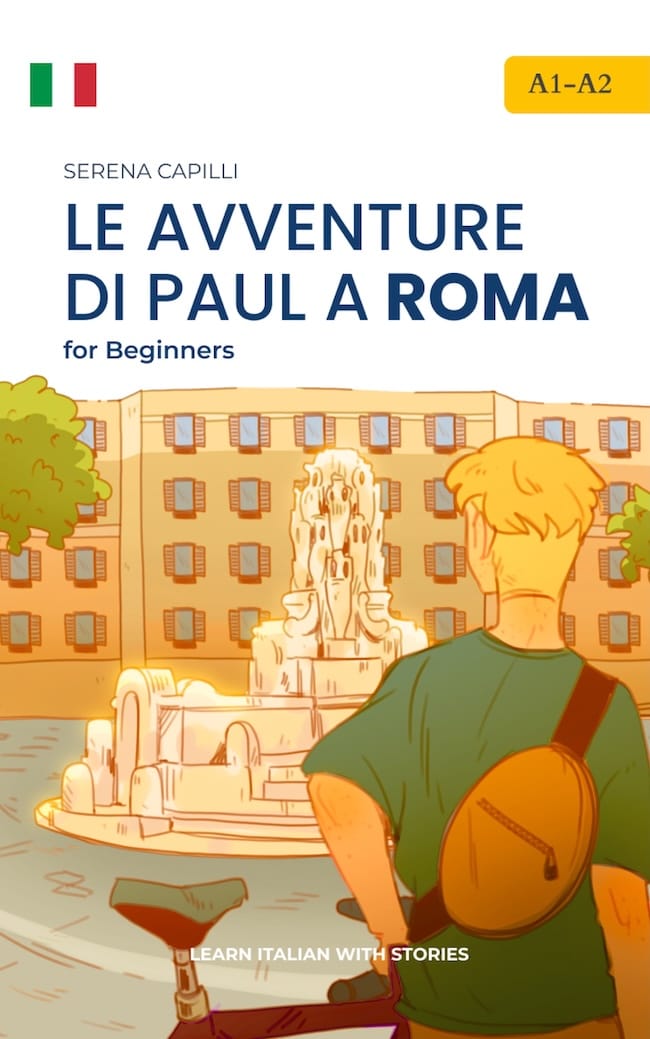
Dialogues are where the imperative lives: characters invite each other, give directions, ask for things in shops and cafés. Reading them in context is the easiest way to make these forms natural. These graded readers are a good place to start: