What’s an irregular verb?
An irregular verb in Italian is one that doesn’t follow standard conjugation rules, like verbs ending in -are, -ere, or -ire in Italian. Every language has them, with examples like “to be,” “can,” or “may” in English, while Italian has even more.
It’s important to learn and memorize irregular verbs in Italian because they are the most commonly used verbs in everyday conversation.
In short
- Irregular verbs don’t follow the regular -are, -ere, -ire patterns, and they are the verbs you’ll use most: essere, avere, fare, andare, venire…
- Learn them in the present tense first: the table below has the 17 most common.
- Look for patterns: many verbs add a -g- in the io and loro forms: vengo, tengo, rimango, scelgo.
- Verbs like finire and capire add -isc-: finisco, capisci.
How to Learn Irregular Verbs
Make a list of the most common Italian irregular verbs in your notebook or on flashcards to help you remember them. Note that irregular verbs in the present tense tend to remain irregular when conjugated in other tenses (e.g., past, future) and moods (e.g., conditional, subjunctive).


Ciao, I'm Serena
I'm a certified Italian teacher from Sicily, and I live in Rome. Since 2016 I've been teaching Italian online to English-speaking adults, through stories and comprehensible input. My graded readers grew out of those lessons: short stories in real, culturally rich Italian, with exercises and audio, so you can bring together and activate the grammar and vocabulary you already know. I believe this is the most effective way to learn a language, and to make learning it part of your lifestyle.
You can find exercises on irregular verbs almost everywhere online or in grammar textbooks for beginners.
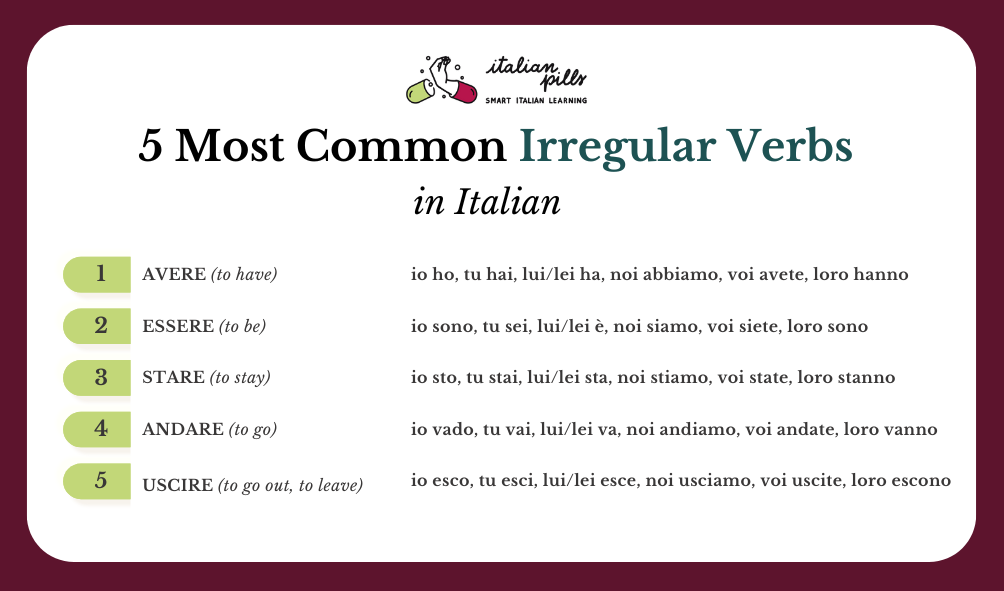
List of the Most Common Italian Irregular Verbs (Present Tense)
| Verb | io, tu, lui/lei | noi, voi, loro |
|---|---|---|
| avere (to have) | ho, hai, ha | abbiamo, avete, hanno |
| essere (to be) | sono, sei, è | siamo, siete, sono |
| stare (to be, to stay) | sto, stai, sta | stiamo, state, stanno |
| andare (to go) | vado, vai, va | andiamo, andate, vanno |
| uscire (to leave, to go out) | esco, esci, esce | usciamo, uscite, escono |
| venire (to come) | vengo, vieni, viene | veniamo, venite, vengono |
| fare (to do, to make) | faccio, fai, fa | facciamo, fate, fanno |
| dare (to give) | do, dai, dà | diamo, date, danno |
| dire (to say, to tell) | dico, dici, dice | diciamo, dite, dicono |
| scegliere (to choose) | scelgo, scegli, sceglie | scegliamo, scegliete, scelgono |
| rimanere (to remain) | rimango, rimani, rimane | rimaniamo, rimanete, rimangono |
| tenere (to keep) | tengo, tieni, tiene | teniamo, tenete, tengono |
| bere (to drink) | bevo, bevi, beve | beviamo, bevete, bevono |
| sapere (to know) | so, sai, sa | sappiamo, sapete, sanno |
| volere (to want) | voglio, vuoi, vuole | vogliamo, volete, vogliono |
| potere (can, may) | posso, puoi, può | possiamo, potete, possono |
| dovere (must, to have to) | devo, devi, deve | dobbiamo, dovete, devono |
Spot the patterns
Irregular doesn’t mean random. Here are three little families that make these verbs much easier to remember:
| Pattern | Verbs | Example |
|---|---|---|
| -g- in io and loro | venire, tenere, rimanere, scegliere, salire | vengo, vengono; tengo, tengono |
| modal verbs | dovere, potere, volere | devo, posso, voglio |
Irregular Italian Verbs Ending in “-IRE”:
A number of verbs in the third conjugation are often called semi-irregular, although they follow their own regular pattern. These are the -ire verbs that follow an irregular pattern. This category includes some very common verbs, such as “capire” (to understand), “finire” (to finish), or “pulire” (to clean). These verbs add the infix “-isc-” to all persons except the first and second person plural (noi and voi), as shown in the examples below.
Note that the infix “-isc” is used only in the present tense, the present subjunctive and the imperative but not in the other tenses and moods.
| io | finisco |
| tu | finisci |
| lui, lei | finisce |
| noi | finiamo |
| voi | finite |
| loro | finiscono |
More verbs adding the infix “isc”:
- Capire (to understand)
- Costruire (to build)
- Pulire (to clean)
- Preferire (to prefer)
- Restituire (to return something)
- Spedire (to send, to ship)
Read more
- Italian verbs with -isc-
- How to conjugate Italian verbs
- Most common -ire verbs
- Irregular passato prossimo verbs
- Essere vs stare
Quick practice: irregular verbs
Frequently asked questions
What are the most common irregular verbs in Italian?
The most common are essere, avere, fare, andare, venire, dire, dare, stare, uscire, bere, sapere and the modal verbs dovere, potere and volere. They are also the verbs you use most in everyday conversation.
How can I learn Italian irregular verbs faster?
Start with the present tense of the 10 most common verbs, learn them in short sentences rather than as lists, and look for patterns like the -g- in vengo, tengo and rimango. Reading short stories helps you see them again and again in context.
Is “dà” written with an accent?
Yes. “Lui dà” (he gives) has an accent to distinguish it from the preposition “da” (from). “Io do” (I give) has no accent.
Practice with my stories
Irregular verbs are the backbone of every conversation, so you’ll meet them on every page of my stories. Reading is the most painless way to make them automatic:
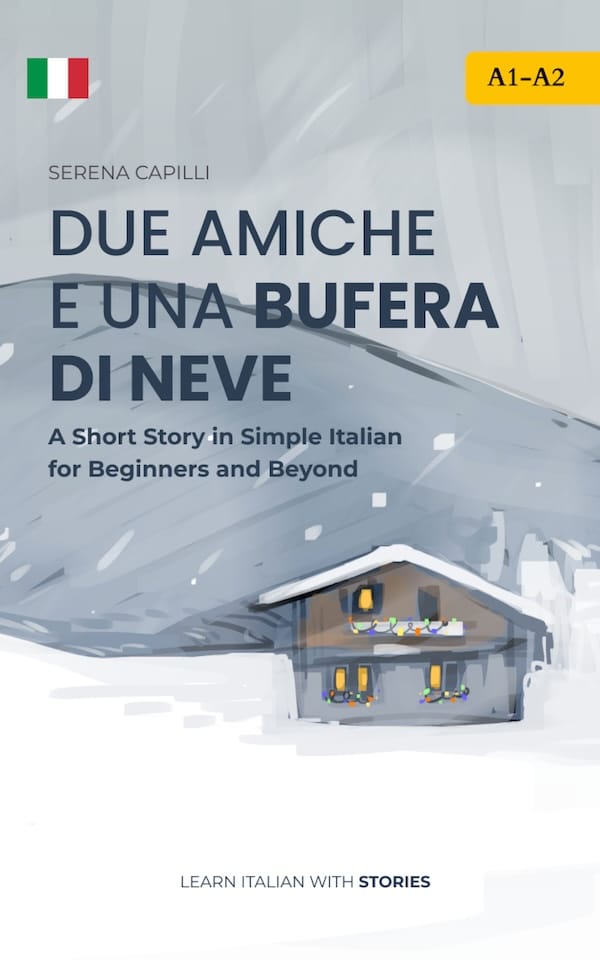
Due Amiche e una Bufera di Neve
Level A1/A2
Costanza and Anna are back for a winter adventure in Valle d’Aosta.