Essere and stare can both translate as “to be,” and that’s exactly why they confuse learners (Spanish speakers, I’m looking at you!). In Italian the rule is simpler than in Spanish: essere is the default “to be,” while stare is used in a set of specific situations: how you are, where you stay, how clothes look on you, and the present continuous.
In short
- Essere = to be: who or what something is, where it’s from, what it’s like, where it is: Sono di Roma. Roma è bellissima.
- Stare = to be or to stay in specific uses: health (Come stai?), staying somewhere (Oggi sto a casa), how something suits you (Ti sta bene!).
- Stare + gerund = present continuous: Sto cucinando. Stare per = to be about to: Sto per uscire.
- Both have the same past participle, stato: Sono stato a Roma means “I was / I’ve been in Rome.”
How to use essere
| Use | Italian | English |
|---|---|---|
| identity and nationality | Sono Serena e sono italiana. | I’m Serena and I’m Italian. |
| profession | Sono un’insegnante di italiano. | I’m an Italian teacher. |
| origin | Sono di Milano. | I’m from Milan. |
| appearance and personality | Sono alta e simpatica. | I’m tall and friendly. |
| describing places and things | Roma è una bella città. La mia casa è luminosa. | Rome is a beautiful city. My house is bright. |
| where something is | Dov’è la mia borsa? È sulla sedia. | Where’s my bag? It’s on the chair. |
| time and dates | Sono le otto. Oggi è lunedì. | It’s eight o’clock. Today is Monday. |
And to say “there is / there are,” Italian uses esserci: C’è un bar, ci sono due bar. Read my guide to essere vs esserci.
How to use stare
1. How you are (health and mood)
| Italian | English |
|---|---|
| Come stai? | How are you? |
| Sto bene, grazie. | I’m well, thanks. |
| Sto male. | I’m not well. |
| Sto meglio. | I’m better. |
2. Staying somewhere
Here stare means “to stay” or “to remain” (rimanere):

Ciao, I'm Serena
I'm a certified Italian teacher from Sicily, and I live in Rome. Since 2016 I've been teaching Italian online to English-speaking adults, through stories and comprehensible input. My graded readers grew out of those lessons: short stories in real, culturally rich Italian, with exercises and audio, so you can bring together and activate the grammar and vocabulary you already know. I believe this is the most effective way to learn a language, and to make learning it part of your lifestyle.
| Italian | English |
|---|---|
| Oggi sto a casa. | Today I’m staying home. |
| Stiamo a Roma per tre giorni. | We’re staying in Rome for three days. |
| Stai tranquillo, ci penso io. | Don’t worry, I’ll take care of it. |
A regional note
In Central and Southern Italy (in Rome, where I live, and in my Sicily) you’ll hear stare much more often for “to be” in a place: Sto a casa, Mario sta in cucina. In the North, people tend to say Sono a casa, Mario è in cucina. Both are understood everywhere.
3. How something suits you
Stare bene / stare male a qualcuno means that something looks good (or bad) on someone:
| Italian | English |
|---|---|
| Questa giacca ti sta benissimo! | This jacket looks great on you! |
| Quel cappello mi sta male. | That hat doesn’t suit me. |
4. Expressions with stare
| Expression | English | Example |
|---|---|---|
| stare in piedi | to be standing | Sto in piedi da tre ore! |
| stare seduto | to be sitting | Stai seduto, arrivo subito. |
| stare zitto | to be quiet | Stai zitto un attimo! |
| stare attento | to pay attention, to be careful | Stai attento alla strada! |
| stare calmo | to stay calm | Stai calmo, non è successo niente. |
| stare a cuore | to care about | La tua felicità mi sta a cuore. |
| stare con qualcuno | to be in a relationship with | Sto con Marco da due anni. |
Essere or stare in these expressions? With positions and states, both are possible: sono seduto simply describes the state, while sto seduto suggests staying in that position for a while. With instructions, stare is the natural choice: Stai calmo! Stai attento!
5. Stare + gerund: the present continuous
To describe an action happening right now, use stare + gerund (-ando, -endo):
| Italian | English |
|---|---|
| Sto cucinando. | I’m cooking. |
| Sto parlando al telefono con Maria. | I’m on the phone with Maria. |
| Cosa stai facendo? | What are you doing? |
6. Stare per + infinitive: to be about to
| Italian | English |
|---|---|
| La lezione sta per finire. | The lesson is about to end. |
| Sto per uscire. | I’m about to go out. |
| Il treno sta per partire. | The train is about to leave. |
Present tense of stare
| Stare | Essere | |
|---|---|---|
| io | sto | sono |
| tu | stai | sei |
| lui / lei / Lei | sta | è |
| noi | stiamo | siamo |
| voi | state | siete |
| loro | stanno | sono |
Good to know: in the passato prossimo, essere and stare look the same: sono stato/a. So Sono stata a Roma can mean “I was in Rome” or “I stayed in Rome,” and Sono stato male means “I was sick.”
Exercise: essere or stare?
- Ciao Luca, come ______? (tu)
- Io ______ di Napoli, e tu?
- Quel vestito ti ______ benissimo!
- Non posso parlare, ______ guidando. (io)
- La farmacia ______ in Piazza Garibaldi.
- Muoviti, il film ______ per cominciare!
Show the answers
- stai
- sono
- sta
- sto
- è
- sta
Frequently asked questions
What is the difference between essere and stare?
Essere is the general verb “to be”: identity, origin, descriptions and location. Stare is used for health (come stai?), for staying somewhere, for how clothes suit you and for the present continuous (sto mangiando).
Do you say “come sei” or “come stai”?
Come stai? asks how you are (your health or mood). Come sei? asks what you’re like (your personality or appearance).
How do you form the present continuous in Italian?
Use stare + gerund: sto parlando, stai mangiando, stiamo leggendo.
What is the past participle of stare?
Stato, the same as essere. Sono stato a Roma can mean “I was in Rome” or “I stayed in Rome.”
Practice with my stories
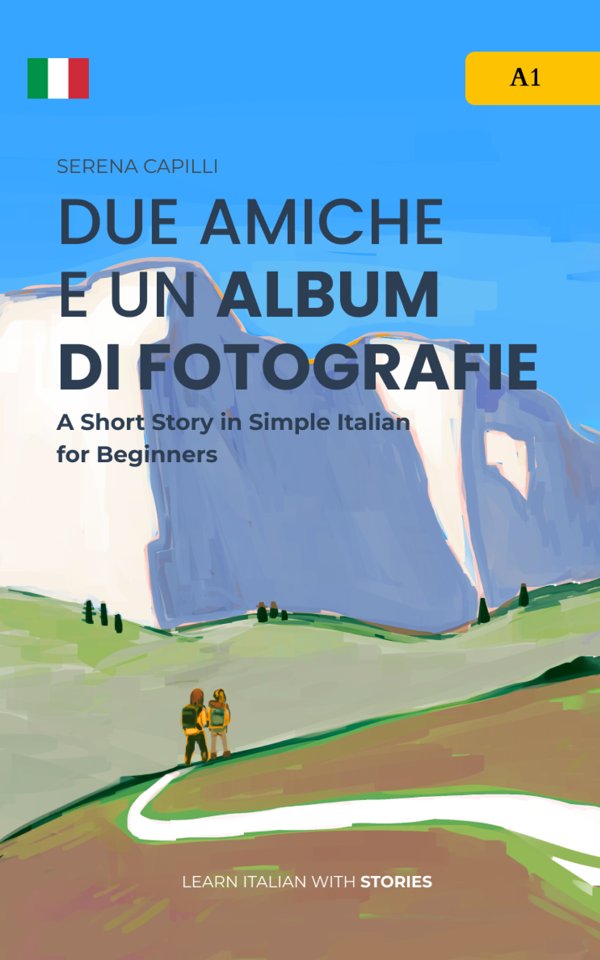
Essere and stare are on every page of my stories, from Come stai? to Sto per partire! Here are three readers to see them in context:
Due Amiche e un Album di Fotografie
Level A1
Two friends, an old photo album and a trip through southern Italy.
Dive deeper: essere vs esserci · how to use ecco · Italian verb conjugation