If you’ve ever taken an Italian class, I’m sure your teacher made you spend a lot of time on conjugation drills: parlo, parli, parla… ho parlato, hai parlato… parlerò, parlerai… I know it can feel frustrating. But once you understand why Italian verbs change so much, the drills start to make sense, and conjugation becomes much easier.
In short
- Italian often drops the subject pronoun (io, tu…): the verb ending tells you who is doing the action. Parlo = I speak.
- Every verb has six forms, one for each person: io, tu, lui/lei, noi, voi, loro.
- Regular verbs end in -are, -ere or -ire: remove the ending to get the stem (parl-), then add the right ending (parl-o).
- Irregular verbs (like essere, avere, dire, volere) change their stem: learn the most common ones by heart.
- As a beginner, start with the present and the passato prossimo: they’re enough for everyday conversation.
Why conjugation matters so much in Italian
In English, you always say the subject: I work, you work, we work. The verb barely changes, because the pronoun does the job. In Italian it’s the opposite: we usually leave out the subject pronoun, so the ending of the verb is the only thing that tells you who is doing the action, and when.
| Italian | English | Who? The ending tells you |
|---|---|---|
| Parlo italiano. | I speak Italian. | -o = io |
| Parli italiano? | Do you speak Italian? | -i = tu |
| Parliamo italiano. | We speak Italian. | -iamo = noi |
| Parlerò con Marco. | I’ll talk to Marco. | -erò = io, in the future |
That’s why Parlo italiano is perfectly complete: you don’t need io. We only add the pronoun for emphasis or contrast: Io parlo italiano, lui no. (I speak Italian, he doesn’t.)
The six persons of an Italian verb
Italian verbs change according to six persons. Here are the subject pronouns:
| Pronoun | Person | English |
|---|---|---|
| io | 1st person singular | I |
| tu | 2nd person singular | you (one person, informal) |
| lui / lei | 3rd person singular | he / she |
| Lei | 3rd person singular, formal | you (formal, one person) |
| noi | 1st person plural | we |
| voi | 2nd person plural | you (two or more people) |
| loro | 3rd person plural | they |
Notice that the formal Lei (you) uses the same verb form as lui/lei: Lei parla inglese? (Do you speak English?) More on this in the questions section below.
How to conjugate a regular verb in 3 steps
- Start from the infinitive. It’s the form you find in the dictionary, like “to + verb” in English: parlare (to speak), prendere (to take), dormire (to sleep). Italian infinitives end in -are, -ere or -ire.
- Find the stem. Remove the last three letters: parlare → parl-, prendere → prend-, dormire → dorm-.
- Add the ending for the person and the tense you need: parl-o (I speak), parl-avo (I used to speak), parl-erò (I’ll speak).
Present tense: the three regular groups
Here are the present tense endings of the three groups, with one example verb each. The fourth column shows -ire verbs like finire, which add -isc- in some persons.
| parlare (-are) | prendere (-ere) | dormire (-ire) | finire (-ire, -isc-) | |
|---|---|---|---|---|
| io | parlo | prendo | dormo | finisco |
| tu | parli | prendi | dormi | finisci |
| lui / lei / Lei | parla | prende | dorme | finisce |
| noi | parliamo | prendiamo | dormiamo | finiamo |
| voi | parlate | prendete | dormite | finite |
| loro | parlano | prendono | dormono | finiscono |
Read more about -isc verbs and the Italian present tense.
Two spelling details
- -iare verbs keep only one i: mangiare → tu mangi (not mangii), studiare → tu studi.
- -care and -gare verbs add an h to keep the hard sound: cercare → tu cerchi, noi cerchiamo; pagare → tu paghi.
Irregular verbs: when the stem changes
The rules above work for regular verbs, which are the vast majority: studiare, lavorare, ballare, cominciare, vendere, partire… Irregular verbs don’t follow the pattern: their stem changes, and some forms are completely unique.
For example, dire (to say) uses the stem dic- in most persons, and volere (to want) switches between vogl-, vuo- and vol-:
| essere (to be) | avere (to have) | dire (to say) | volere (to want) | |
|---|---|---|---|---|
| io | sono | ho | dico | voglio |
| tu | sei | hai | dici | vuoi |
| lui / lei / Lei | è | ha | dice | vuole |
| noi | siamo | abbiamo | diciamo | vogliamo |
| voi | siete | avete | dite | volete |
| loro | sono | hanno | dicono | vogliono |
My tip: don’t study irregular verbs as a list of rules. Learn the most common ones by heart, in short sentences you actually use: Sono stanca. Ho fame. Che dici? Vuoi un caffè? Here’s my list of the 17 most common Italian irregular verbs and how to learn them.
Conjugating verbs in questions
Italian doesn’t use helpers like “do,” “does” or “did” to ask a question. You use the same conjugated verb and simply raise your voice at the end: Parli inglese? (Do you speak English?)
What changes is the person, depending on who you’re talking to:
| Who you’re talking to | Question | English |
|---|---|---|
| tu: one person, informal | Scusa, parli inglese? | Excuse me, do you speak English? |
| Lei: one person, formal | Scusi, parla inglese? | Excuse me, do you speak English? (polite) |
| voi: two or more people | Scusate, parlate inglese? | Excuse me, do you (all) speak English? |
And when you ask about someone else: Parla inglese? (Does he/she speak English?), Parlano inglese? (Do they speak English?)
The verb also changes with the tense:
| Italian | English | Tense |
|---|---|---|
| Viaggi molto? | Do you travel a lot? | Present |
| Hai viaggiato molto? | Have you traveled a lot? | Passato prossimo |
| Viaggerai molto? | Will you travel a lot? | Future |
Which tenses should beginners learn first?
Italian has many tenses, but you don’t need them all at the beginning. Even native speakers use only a handful in everyday conversation. With the present (presente) and the passato prossimo (the most common past tense), you can already hold a real conversation. Then add the imperfetto and the future.
Start here: the passato prossimo explained and passato prossimo vs imperfetto.
Italian verb conjugation chart: parlare in the main tenses
| Tense | io | tu | lui / lei / Lei | noi | voi | loro |
|---|---|---|---|---|---|---|
| Presente (present) | parlo | parli | parla | parliamo | parlate | parlano |
| Passato prossimo (I spoke / I have spoken) | ho parlato | hai parlato | ha parlato | abbiamo parlato | avete parlato | hanno parlato |
| Imperfetto (I was speaking / I used to speak) | parlavo | parlavi | parlava | parlavamo | parlavate | parlavano |
| Futuro semplice (I will speak) | parlerò | parlerai | parlerà | parleremo | parlerete | parleranno |
| Condizionale (I would speak) | parlerei | parleresti | parlerebbe | parleremmo | parlereste | parlerebbero |
| Congiuntivo presente (that I speak) | (che) parli | (che) parli | (che) parli | (che) parliamo | (che) parliate | (che) parlino |
| Imperativo (speak!) | parla! | parli! (Lei) | parliamo! | parlate! |
Tools to check any conjugation
When you need a full conjugation chart for any verb, these free tools are reliable:
Use them to check, not to memorize. Nobody learns every form of every tense, and you’ll never need to.
How I’d learn conjugations (without endless drills)
- One tense at a time. Master the present before moving on.
- Say the forms out loud, in short sentences about your own life: Lavoro a casa. Tu dove lavori?
- Learn verbs in chunks: ho fame, che dici, vuoi venire? stick much better than tables.
- Read easy stories: you’ll meet the same forms again and again, in context, until they feel natural.
More tips in the 60 most common Italian verbs.
Exercise: conjugate in the present tense
- Io ______ (parlare) tre lingue.
- Tu ______ (prendere) un caffè?
- Noi ______ (dormire) fino alle nove.
- Loro ______ (finire) di lavorare alle sei.
- Voi ______ (essere) di Roma?
- Lei ______ (volere) un bicchiere d’acqua, signora?
Show the answers
- parlo
- prendi
- dormiamo
- finiscono
- siete
- vuole
Frequently asked questions
How do you conjugate a verb in Italian?
Start from the infinitive (parlare, prendere, dormire), remove the -are, -ere or -ire ending to get the stem (parl-), then add the ending for the person and tense: parlo, parli, parla, parliamo, parlate, parlano.
Do I need subject pronouns in Italian?
Usually not. The verb ending already tells you who is doing the action, so Parlo italiano is complete. Italians add io, tu, lui and so on only for emphasis or contrast.
Which Italian tenses should I learn first?
Start with the present (presente) and the passato prossimo. They cover most everyday conversation. Then add the imperfetto and the future.
How many conjugations are there in Italian?
There are three groups of regular verbs, by infinitive ending: -are, -ere and -ire. Some -ire verbs, like finire, add -isc- in some persons.
Practice with my stories
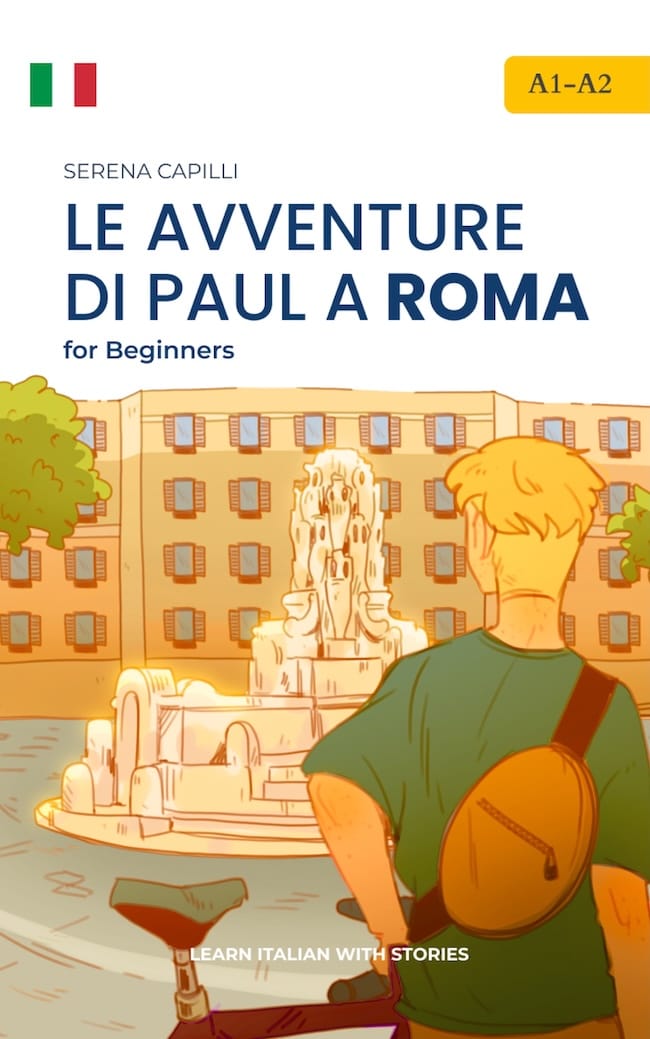
The fastest way to make conjugations feel natural is to read them in a story. My readers for beginners use simple, everyday verbs, with a vocabulary list and audio for every chapter:
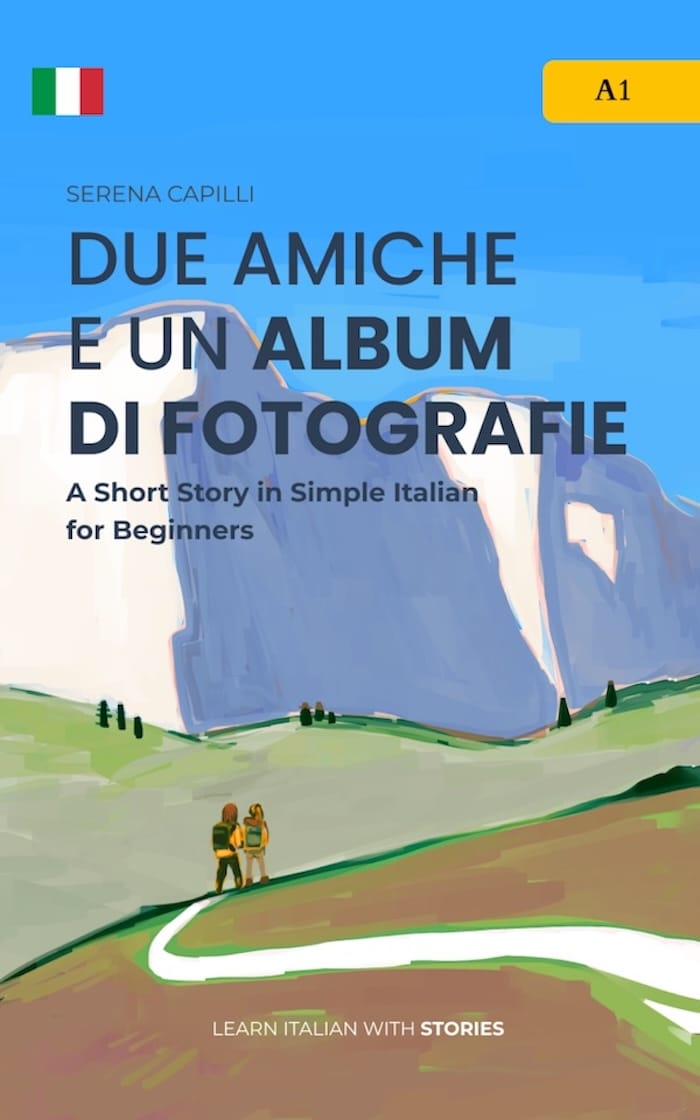
Due Amiche e un Album di Fotografie
Level A1
Two friends, an old photo album and a trip through southern Italy.

Dive deeper: irregular verbs · -isc verbs · reflexive verbs · Italian sentence structure