Ci and ne are two tiny words (called particelle in Italian) that native speakers use all the time. They replace something already mentioned, so we don’t have to repeat it. They make your Italian shorter, more fluid and much more natural.
They can look scary at first, because each one has several uses. But the logic is simple, and in this guide I’ll show you, step by step, how they work.
In short
- Ne replaces something introduced by di: Parlo di politica → Ne parlo (I talk about it)
- Ne replaces a quantity: Quanti figli hai? Ne ho due (I have two)
- Ci replaces a place: Vai a Roma? Sì, ci vado (I go there)
- Ci replaces something introduced by a, in, su, con: Pensi al viaggio? Ci penso (I think about it)
- Both go before the verb, but attach to infinitives and imperatives: parlarne, andiamoci
Ci and ne at a glance
| Ne | Ci | |
|---|---|---|
| Replaces… | di + something; a quantity | a place; a / in / su / con + something |
| Means… | of it, about it, some, of them | there, about it, on it, with it |
| Example | Ne parlo. Ne voglio due. | Ci vado. Ci penso. |
| Other uses | from there (me ne vado) | us (ci vedi?), reflexive noi (ci alziamo), c’è / ci sono |
Jump to
How to use ne
Ne has two main uses: it replaces something introduced by di, and it replaces a quantity.
1. Ne = about it, of it (di + something)
Many Italian verbs and expressions are followed by di. When you don’t want to repeat what comes after di, you replace it with ne.
| Italian | English |
|---|---|
| Parlo spesso dello studio delle lingue. | I often talk about language learning. |
| Ne parlo spesso. | I often talk about it. |
The easiest way to use ne correctly is to learn the verbs that are followed by di. These are the most common:
| Verb + di | English |
|---|---|
| parlare di | to talk about |
| pensare di | to think of (an opinion) |
| avere bisogno di | to need |
| essere sicuro di | to be sure about |
| avere voglia di | to feel like |
| avere paura di | to be afraid of |
| avere nostalgia di | to miss, to be homesick for |
| Italian | English | What it replaces |
|---|---|---|
| Che pensi di Maria? → Che ne pensi? | What do you think of her? | di Maria |
| Parliamo di politica? → Ne parliamo? | Shall we talk about it? | di politica |
| Hai bisogno della macchina? → No, non ne ho bisogno. | No, I don’t need it. | della macchina |
| Sei sicuro di quello che hai detto? → Sì, ne sono sicuro. | Yes, I’m sure about it. | di quello che hai detto |
2. Ne = some, of them (quantities)
The second use of ne is with quantities: it means “some of it” or “some of them.” It’s typical in answers to quanto? and quanti? (how much? how many?), and after numbers or words like un po’, molti, nessuno.
| Italian | English | What it replaces |
|---|---|---|
| Vuoi del formaggio? Sì, ne voglio un po’. | Do you want some cheese? Yes, I want some. | del formaggio |
| Vuoi una fetta di torta? No, ne voglio due! | Do you want a slice of cake? No, I want two! | fette di torta |
| Quanti figli hai? Ne ho due. | How many children do you have? I have two. | figli |
| Quanti libri hai letto? Ne ho letto uno. | How many books have you read? I’ve read one. | libri |
Careful with the passato prossimo
When ne replaces a quantity, the past participle agrees with the thing it replaces: Quante mele hai mangiato? Ne ho mangiate tre.
Ci sono or ce ne sono?
- Ci sono = there are: Quante finestre ci sono in questa stanza? (How many windows are there in this room?)
- Ce ne sono = there are some (of them): Ce ne sono tre. (There are three.)
When ci and ne meet, ci becomes ce: ce n’è uno, ce ne sono due.
Where does ne go in the sentence?
Ne usually goes before the conjugated verb: ne parlo. With an infinitive, an imperative or a gerund, it attaches to the end of the verb (and the infinitive drops its final -e):
| Italian | English |
|---|---|
| Voglio parlarne. | I want to talk about it. |
| Parlane! | Talk about it! |
| Parlandone, ho capito. | By talking about it, I understood. |
In short
Ne means “of it, about it” (replacing di + something) or “some, of them” (replacing a quantity).
How to use ci
Ci has even more uses than ne. Here are the ones you need every day.
1. Ci = there (places)
Ci replaces a place you’ve already mentioned, usually introduced by a, in, da or su.
| Italian | English | What it replaces |
|---|---|---|
| Sei stato a Londra? Sì, ci sono stato. | Have you been to London? Yes, I’ve been there. | a Londra |
| Quando vai in montagna? Ci vado domenica. | When are you going to the mountains? I’m going there on Sunday. | in montagna |
| Vai a Milano ogni venerdì? Sì, ci vado. | Do you go to Milan every Friday? Yes, I go there. | a Milano |
That’s also why Italians say c’è (there is) and ci sono (there are).
2. Ci = about it, on it, in it, with it
This use works like ne, but with different prepositions: ci replaces something introduced by a, in, su or con. These are the most common verbs:
| Verb + preposition | English |
|---|---|
| pensare a | to think about |
| credere a / in | to believe (in) |
| contare su | to count on |
| riuscire a | to manage to |
| fare caso a | to notice |
| stare a | to agree to, to be up for |
| Italian | English | What it replaces |
|---|---|---|
| Pensi spesso al viaggio? Sì, ci penso sempre. | Do you often think about the trip? Yes, all the time. | al viaggio |
| Credi in Dio? Sì, ci credo. | Do you believe in God? Yes, I do. | in Dio |
| Conti sul suo aiuto? Sì, ci conto. | Are you counting on his help? Yes, I am. | sul suo aiuto |
| Sei riuscito a finire? No, non ci sono riuscito. | Did you manage to finish? No, I didn’t. | a finire |
With people, Italians usually say penso a lei, conto su di te. Using ci for people is common in spoken Italian, but it’s more natural with things and ideas.
3. Ci = us
Ci is also the object pronoun for noi (us):
| Italian | English |
|---|---|
| Ci chiami stasera? | Will you call us tonight? |
| Ci dai una mano? | Can you give us a hand? |
| Dicci tutto! | Tell us everything! |
4. Ci in reflexive verbs
Finally, ci is the reflexive pronoun for noi:
| Italian | English |
|---|---|
| Ci svegliamo presto. | We wake up early. |
| Ci vediamo domani! | See you tomorrow! |
| Ci rilassiamo al mare. | We relax at the beach. |
In short
Ci means “there,” “about/on/in it,” “us,” and it’s the reflexive pronoun for noi.
Smart tip
The best way to internalize ci and ne is to learn them in context, in everyday expressions:
- Ci penso io: I’ll take care of it
- Ci conto: I’m counting on it
- Ne parliamo?: Shall we talk about it?
- Ne vuoi?: Do you want some?
- Me ne vado: I’m leaving
Memorize these phrases and you’ll avoid a lot of frustration and sound much more natural in Italian.
Common mistake: lì or ci?
Students often mix up lì and ci, because both can mean “there.” But they work differently.
- Lì (or là) is an adverb: it points to a place, often one you can see. Il gatto è lì. (The cat is there.) Vado là. (I’m going over there.)
- Ci is a pronoun: it replaces a place already mentioned in the conversation, and goes before the verb. Vai a Roma? Sì, ci vado. (Yes, I’m going there.)
Pronominal verbs with ci and ne
Some Italian verbs, called verbi pronominali, include ci, ne or both, and take on a new meaning:
| Verb | Meaning |
|---|---|
| tenerci | to care about something |
| andarsene | to go away, to leave |
| volerci | to take (time) |
| farcela | to make it, to manage |
This is a more advanced topic. If your Italian is already good, read my guide to Italian pronominal verbs. If you’re a beginner, you can skip it for now.
Practice
Frequently asked questions
What is the difference between ci and ne in Italian?
Ne replaces something introduced by di (Ne parlo = I talk about it) or a quantity (Ne voglio due). Ci replaces a place (Ci vado = I go there) or something introduced by a, in, su or con (Ci penso = I’ll think about it).
What does “ce ne sono” mean?
Ce ne sono means “there are some (of them).” It answers questions with quanti or quante: Quante finestre ci sono? Ce ne sono tre.
Where do ci and ne go in the sentence?
Usually before the conjugated verb (Ci vado, Ne parlo). With infinitives, imperatives and gerunds they attach to the end: Voglio andarci, Parlane!
Ci and ne are everywhere in spoken Italian, and in my stories too. Reading them in context is the fastest way to start using them without thinking. Here are three to try:
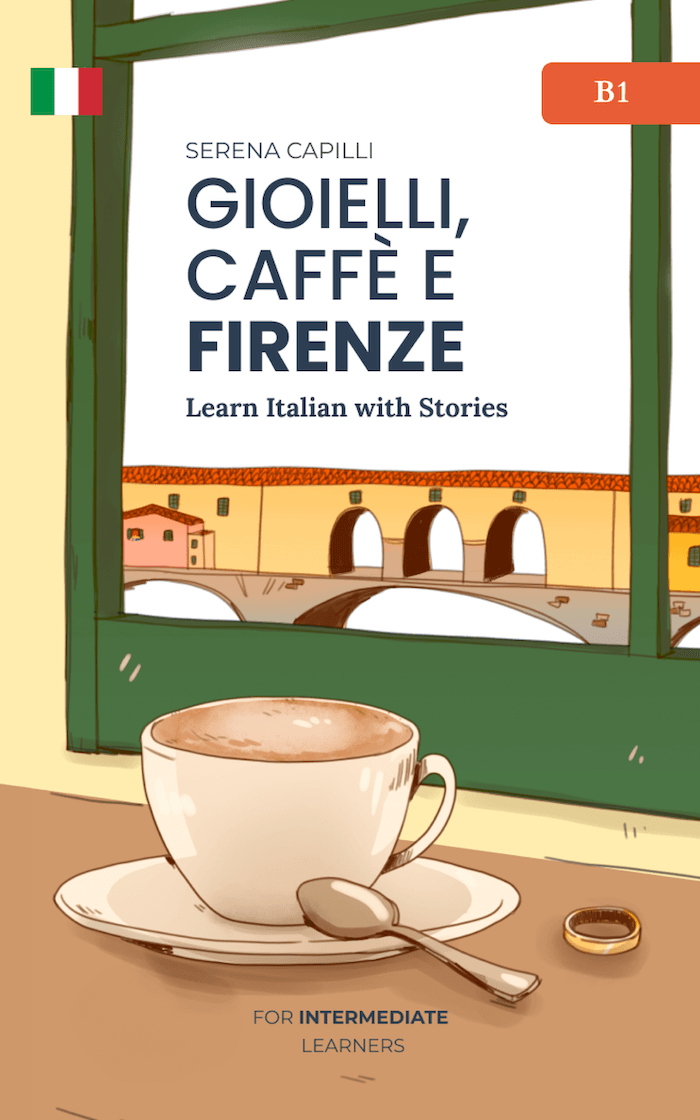
Gioielli, Caffè e Firenze
Level B1+
Marie moves to Florence, where jewelry making leads to a new life.

Cioccolato, Amore e Torino
Level B1+
Marie’s journey continues in Turin, between love, creativity and chocolate.
Dive deeper: Italian indirect object pronouns · Italian pronominal verbs · volerci vs. metterci