Me lo dai? Glielo dico. Dammelo! Double object pronouns look like a tongue twister at first, but they follow a few clear patterns. Once you see them, you’ll start hearing them everywhere in spoken Italian.
In short
- A double pronoun is an indirect pronoun + a direct pronoun (or ne): Te lo do = I give it to you.
- The indirect pronoun always comes first and changes its vowel: mi → me, ti → te, ci → ce, vi → ve, si → se.
- Gli and le both become glie- and join the next pronoun in one word: glielo, gliela, glieli, gliele, gliene.
- They go before a conjugated verb but attach to infinitives and informal commands: Posso dartelo? Dammelo!
- In the passato prossimo, the participle agrees with lo, la, li, le: Gliel’ho data (la lettera).
What are double object pronouns?
In Italian you can replace both the thing and the person in a sentence with pronouns. The thing is the direct object (lo, la, li, le, ne), the person is the indirect object (mi, ti, gli, le, ci, vi). Put them together and you get a double pronoun.
- Do il libro a Marta. (I give the book to Marta.)
- Le do il libro. (I give her the book.)
- Lo do a Marta. (I give it to Marta.)
- Glielo do. (I give it to her.)
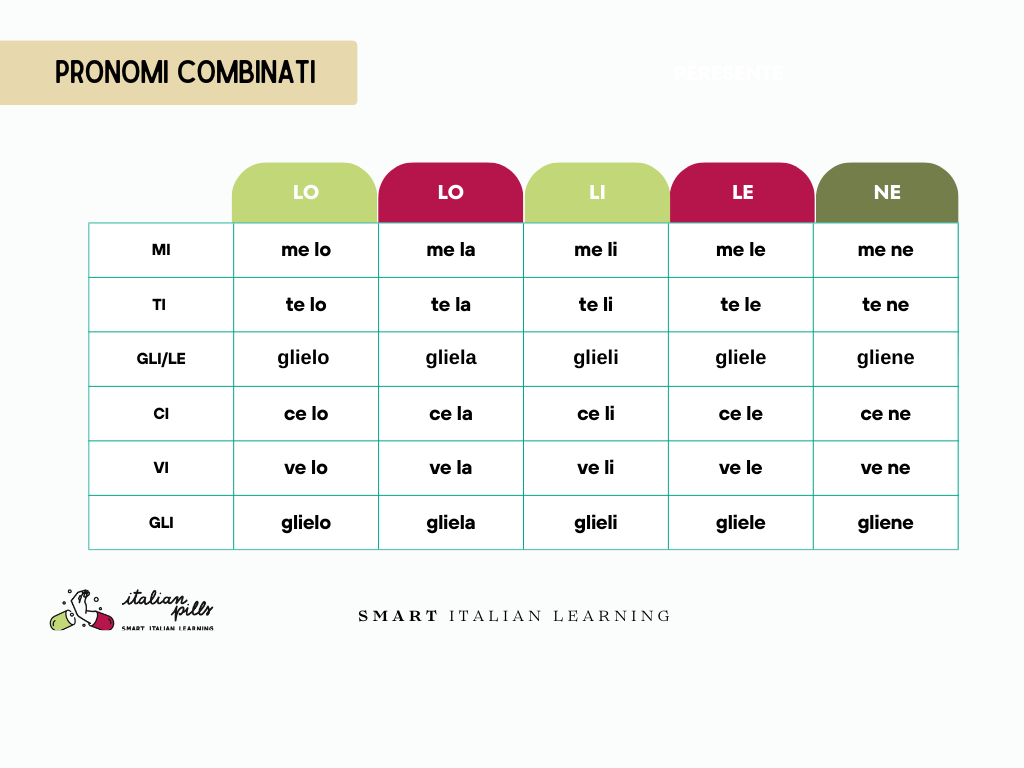
Double object pronouns chart
Here is every combination. Notice that the indirect pronoun always comes first, and that its -i turns into -e.
| Indirect | + lo | + la | + li | + le | + ne |
|---|---|---|---|---|---|
| mi | me lo | me la | me li | me le | me ne |
| ti | te lo | te la | te li | te le | te ne |
| gli / le | glielo | gliela | glieli | gliele | gliene |
| ci | ce lo | ce la | ce li | ce le | ce ne |
| vi | ve lo | ve la | ve li | ve le | ve ne |
| gli (to them) | glielo | gliela | glieli | gliele | gliene |
| si (reflexive) | se lo | se la | se li | se le | se ne |
With loro (to them) you may also see the formal written order Lo do loro, but in everyday Italian people say Glielo do.
Where do double pronouns go?
The rules are the same as for single pronouns. If you need a refresher, start with my guide to direct object pronouns.
| Where | Rule | Example |
|---|---|---|
| Conjugated verb | Before the verb | Te lo prometto. (I promise you.) |
| Negative sentence | After non, before the verb | Non glielo dico. (I won’t tell him.) |
| Infinitive | Attached at the end (drop the final -e) | Voglio dartelo. (I want to give it to you.) |
| Modal + infinitive | Before the modal or attached to the infinitive | Te lo posso dare. / Posso dartelo. |
| Stare + gerund | Before stare or attached to the gerund | Te la sto scrivendo. / Sto scrivendotela. |
| Informal command (tu, noi, voi) | Attached at the end | Dimmelo! (Tell me!) Portateceli! (Bring them to us!) |
| Formal command (Lei) | Before the verb | Me lo dica, per favore. (Tell me, please.) |
When you attach pronouns to a one-syllable command like da’, di’, fa’, sta’, va’, the first consonant doubles: Dammelo! (Give it to me!), Fammelo vedere! (Let me see it!). The only exception is gli: Diglielo! (Tell him!)
Double pronouns in the passato prossimo
In compound tenses, the double pronoun goes before avere, and the past participle agrees with the direct pronoun. Lo and la usually drop their vowel before ho, hai, ha, hanno (l’ho), but li and le never do.
| Full sentence | With double pronouns |
|---|---|
| Ho dato la lettera a Marco. | Gliel’ho data. |
| Ho regalato i fiori a Giulia. | Glieli ho regalati. |
| Mi hai portato le chiavi? | Sì, te le ho portate. |
| Ci hanno detto il nome. | Ce l’hanno detto. |
| Ti ho comprato due mele. | Te ne ho comprate due. |
Ne with double pronouns: me ne, gliene
Ne means “some of it” or “of them,” and it combines like the other direct pronouns. You’ll use it a lot with numbers and quantities.
- Mi dai del pane? Sì, te ne do un po’. (Yes, I’ll give you some.)
- Quanti biglietti dai a Luca? Gliene do due. (I give him two.)
- Vuoi delle caramelle? Te ne do due. (I’ll give you two.)
Want to go further with ne and ci? Read my guide to ci and ne.
Double pronouns with reflexive verbs
With reflexive verbs, si (and mi, ti, ci, vi) combine with the object in the same way.
- Mi lavo le mani. → Me le lavo. (I wash them.)
- Si mette il cappotto. → Se lo mette. (He puts it on.)
- Ti sei ricordato il biglietto? → Te lo sei ricordato? (Did you remember it?)
You also find double pronouns inside some of the most common everyday verbs: andarsene (to leave), avercela (to be mad at someone), farcela (to make it) and fregarsene (not to care).
Common mistakes
| Wrong | Right | Why |
|---|---|---|
| Me lo dai? | The indirect pronoun goes first. | |
| Me lo dici? | Mi becomes me before another pronoun. | |
| Glielo do. | Glie- and the next pronoun make one word. | |
| Gliel’ho data. | The participle agrees with la. | |
| Glieli ho dati. | Only lo and la drop their vowel, never li and le. |
Practice
Rewrite each sentence with a double pronoun, then open the answers.
- Do il libro a te.
- Mando le foto a Marta.
- Ci porti il caffè?
- Voglio regalare questi fiori a mia madre.
- Ho spiegato la regola agli studenti.
- Dai a me tre biscotti!
Show the answers
- Te lo do.
- Gliele mando.
- Ce lo porti?
- Voglio regalarglieli. / Glieli voglio regalare.
- Gliel’ho spiegata.
- Dammene tre!
Want more practice? Try this interactive exercise.
Practice with my stories
Double pronouns become automatic when you meet them again and again in context. Reading stories written for your level is one of the easiest ways to get there.

Cioccolato, Amore e Torino
Level B1+
Marie’s journey continues in Turin, between love, creativity and chocolate.
Gioielli, Caffè e Firenze
Level B1+
Marie moves to Florence, where jewelry making leads to a new life.
Frequently asked questions
What are double object pronouns in Italian?
They are two pronouns used together: an indirect pronoun (to whom) followed by a direct pronoun (what) or ne. For example, Te lo do means I give it to you.
Why does mi become me in me lo?
When mi, ti, ci, vi and si come before lo, la, li, le or ne, their final -i becomes -e: me lo, te la, ce li, ve le, se ne. It simply makes the pair easier to say.
What does glielo mean?
Glielo means it to him, it to her, it to them or it to you (formal Lei). Gli and le both become glie- and join the direct pronoun in one word.
Where do double object pronouns go in an Italian sentence?
Before a conjugated verb (Te lo dico), but attached to the end of an infinitive, a gerund or an informal command (Voglio dirtelo, Dimmelo!). With modal verbs you can choose either position.
Do double pronouns change the past participle?
Yes. In the passato prossimo, the participle agrees with the direct pronoun lo, la, li or le: Gliel’ho data (la lettera), Glieli ho dati (i libri).