Picture yourself at a market in Italy: you want some bread, some tomatoes, some cheese. In English one little word does all the work. In Italian you have a few options, and the most common one is the partitive article: del pane, dei pomodori, del formaggio.
The good news? If you already know the definite articles, you already know the partitive articles too.
In short
- Partitive article = di + definite article: di + il = del, di + la = della, di + i = dei…
- It means “some” or “a bit of”: del pane (some bread), delle fragole (some strawberries).
- With singular nouns you can also say un po’ di: un po’ di pane.
- With plural nouns you can also say alcuni / alcune or qualche + singular noun.
- In negative sentences, Italians usually drop it: Non ho pane.
What is a partitive article?
Partitive articles are the easiest way to translate “some” in Italian. They indicate a part, or an unspecified amount, of something: not the bread, not a bread, just some bread.
Unlike “some” in English, they change their shape depending on the noun that follows, because they are a combination of di plus the definite article that the noun would use.
How to form the partitive articles
Look at the definite article the noun takes, then add di. That’s it:
| Definite article | di + article | Example | English |
|---|---|---|---|
| il | del | del latte | some milk |
| lo | dello | dello zucchero | some sugar |
| l’ | dell’ | dell’aceto | some vinegar |
| la | della | della pizza | some pizza |
| i | dei | dei ragazzi | some boys |
| gli | degli | degli amici | some friends |
| le | delle | delle amiche | some (female) friends |
Singular partitive articles: del, dello, dell’, della
Use them with things you can’t count, like food and drinks:
- del pane → some bread
- della farina → some flour
- dello zucchero → some sugar
- dell’olio d’oliva → some olive oil
Plural partitive articles: dei, degli, delle
Use them with things you can count, in the plural:
- dei pomodori → some tomatoes
- degli spinaci → some spinach*
- delle fragole → some strawberries
*Note: spinaci is a masculine plural noun in Italian, unlike in English.
Other ways to say “some” in Italian
The partitive article is not the only option. Italians often prefer these, especially in everyday conversation:
| Form | Used with | Example |
|---|---|---|
| un po’ di | singular nouns (uncountable) | un po’ di pane → some bread |
| alcuni / alcune | plural nouns | alcuni pomodori, alcune fragole → some tomatoes, some strawberries |
| qualche | singular nouns only! | qualche pomodoro → some tomatoes |
Un po’ di
All the singular partitive articles can be replaced by un po’ di (“a bit of”). It’s very common and very natural:
- un po’ di pane → some bread
- un po’ di farina → some flour
- un po’ di zucchero → some sugar
- un po’ di olio d’oliva → some olive oil
Alcuni / alcune
The plural partitive articles can be replaced by alcuni (masculine plural) or alcune (feminine plural). They are correct, but a bit less common in everyday speech than dei, degli, delle:
- alcuni pomodori → some tomatoes
- alcune fragole → some strawberries
- alcuni spinaci → some spinach
Qualche
Qualche also means “some”, but here is the trick that surprises my students: it is always followed by a singular noun, even if the meaning is plural.
- Ho comprato qualche pomodoro. → I bought some tomatoes.
- Ho qualche domanda. → I have some questions.
- ❌ qualche pomodori
When you don’t need the partitive
In some sentences Italians simply leave it out:
- In negative sentences: Non ho pane. → I don’t have any bread.
- In many questions: C’è latte? → Is there any milk?
- In quick lists: Compro pane, latte e uova. → I’m buying bread, milk and eggs.
See the partitive in real life: at the market
Buongiorno! Vorrei del pane, un po’ di formaggio e dei pomodori, per favore. Ah, e anche qualche limone. Avete delle fragole? No? Allora prendo della frutta di stagione.
Good morning! I’d like some bread, some cheese and some tomatoes, please. Oh, and a few lemons too. Do you have any strawberries? No? Then I’ll take some seasonal fruit.
Practice with my stories
Food, shopping and everyday life are everywhere in my graded readers, so you’ll meet del, dei and un po’ di again and again. If you’re a beginner, start with one of these:
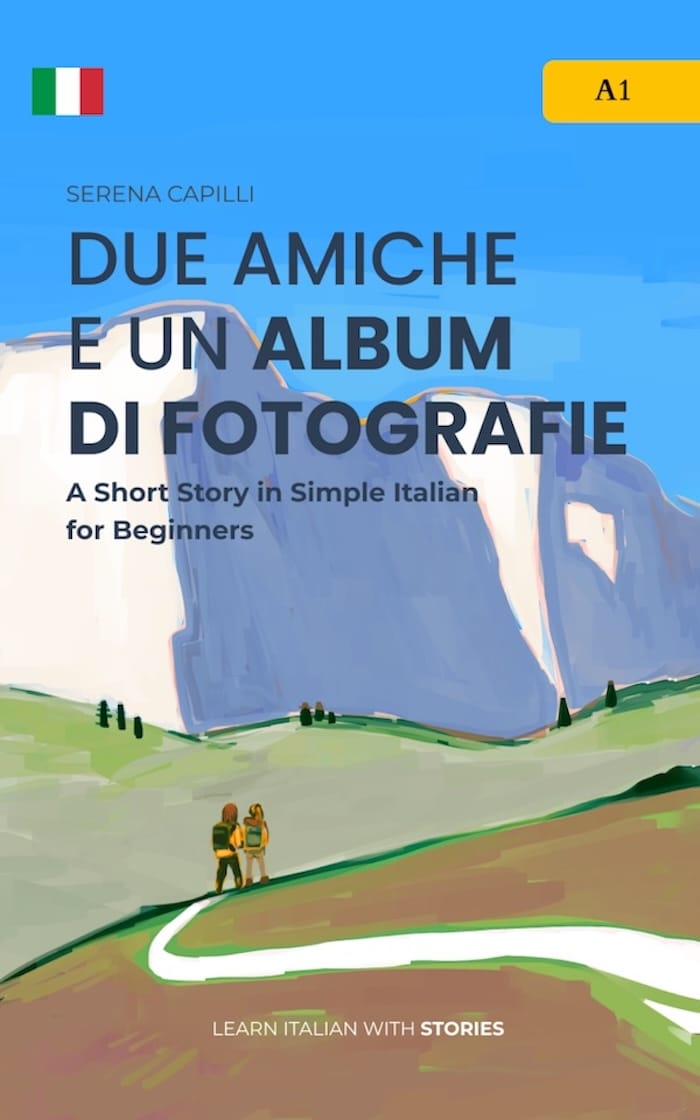
Due Amiche e un Album di Fotografie
Level A1
Two friends, an old photo album and lots of everyday Italian.