If you want your Italian to sound fluent and natural, you need to connect your ideas. Italians use small but powerful words to build long, flowing sentences: conjunctions (congiunzioni) and connectors (connettivi). In this guide you’ll find the most common ones, grouped by what they do, with an example for each.
In short
- Conjunctions join two parts of a sentence: e, ma, o, perché, se, quando.
- Connectors are a wider group: conjunctions, but also adverbs and short phrases like quindi, tuttavia, infatti, in realtà.
- The most useful to start with: perché, quindi, ma, però, anche se, mentre, poi, cioè.
- Some connectors need the subjunctive (congiuntivo): benché, affinché, purché, prima che, a meno che. In the tables they’re marked (+ congiuntivo).
Conjunctions vs connectors
Conjunctions (congiunzioni) are the core grammar words that join two parts of a sentence or two ideas: e (and), ma (but), o (or), perché (because), se (if), quando (when).
Connectors (connettivi) are a broader group of linking words that make your speech more fluid. They include conjunctions, but also adverbs and short phrases like quindi (so), tuttavia (however), allora (then), infatti (in fact) and in realtà (actually).
1. Cause: perché, siccome, poiché
They explain why something happens.
| Connector | Meaning | Example |
|---|---|---|
| perché | because | Non esco perché piove. |
| siccome | since, as (at the start of the sentence) | Siccome fa freddo, resto a casa. |
| poiché | since, as (more formal) | Poiché era tardi, siamo tornati a casa. |
| a causa di | because of | A causa del traffico, sono in ritardo. |
| grazie a | thanks to | Grazie a te, ho imparato molto. |
What’s the difference between perché and siccome? I explain it in perché vs siccome.
2. Result: quindi, perciò, ecco perché
They show the result of an action or an idea.
| Connector | Meaning | Example |
|---|---|---|
| quindi | so, therefore | Era stanco, quindi è andato a dormire. |
| perciò | so, that’s why | Era tardi, perciò siamo andati via. |
| di conseguenza | consequently | Ha studiato molto, di conseguenza ha superato l’esame. |
| per questo (motivo) | for this reason | Non mi piace il freddo, per questo vivo al Sud. |
| ecco perché | that’s why | Aveva fame, ecco perché ha mangiato presto. |
3. Addition: anche, inoltre, oltre a
They add information.
| Connector | Meaning | Example |
|---|---|---|
| e | and | Ho fame e sete. |
| anche | also, too | Vengo anche io. |
| inoltre | also, in addition | La casa è grande. Inoltre, ha un bel giardino. |
| oltre a | besides, in addition to | Oltre all’italiano, studio il francese. |
| né… né | neither… nor | Non bevo né caffè né tè. |
4. Contrast: ma, però, invece, tuttavia
They express a contrast or a contradiction.
| Connector | Meaning | Example |
|---|---|---|
| ma | but | Mi piace viaggiare, ma costa troppo. |
| però | but, however (very common in speech) | È simpatico, però è un po’ pigro. |
| invece | instead, on the other hand | Volevo dormire, invece ho studiato. |
| tuttavia | nevertheless (formal, written) | Non ho tempo, tuttavia verrò. |
| al contrario | on the contrary | Non è difficile, al contrario: è semplicissimo. |
| anzi | actually, on the contrary | Non sono stanca, anzi! |
Read more about anzi.
5. Concession: anche se, benché, nonostante
They say that something happens in spite of something else (“even though”).
| Connector | Meaning | Example |
|---|---|---|
| anche se | even if, even though | Anche se piove, andiamo al mare. |
| benché / sebbene | although, even though (+ congiuntivo) | Benché sia stanco, esce lo stesso. |
| nonostante / malgrado | despite, even though (+ congiuntivo) | Nonostante faccia freddo, usciamo. |
| comunque | anyway, however | Non lo so. Comunque, ti faccio sapere. |
Tip: in everyday speech, anche se (with the indicative) is by far the most common. Benché and sebbene sound more formal.
6. Condition: se, a patto che, a meno che
They introduce a condition.
| Connector | Meaning | Example |
|---|---|---|
| se | if | Se ho tempo, vengo. |
| nel caso in cui | in case, if (+ congiuntivo) | Nel caso in cui piova, restiamo a casa. |
| qualora | if, should (formal) (+ congiuntivo) | Qualora servisse, chiamami. |
| a condizione che / a patto che | provided that (+ congiuntivo) | Ti aiuto, a patto che tu studi. |
| purché | as long as (+ congiuntivo) | Puoi uscire, purché torni presto. |
| a meno che (non) | unless (+ congiuntivo) | Non parto, a meno che tu non venga con me. |
7. Purpose: per, così, affinché
They express a goal or an intention.
| Connector | Meaning | Example |
|---|---|---|
| per + infinitive | to, in order to | Studio per imparare l’italiano. |
| in modo da + infinitive | so as to | Leggo ogni giorno in modo da migliorare il vocabolario. |
| così (informal) | so (that) | Parla piano, così ti capisco. |
| affinché / perché | so that (+ congiuntivo) | Ti spiego tutto affinché tu capisca bene. |
8. Time: prima, poi, mentre
They show when something happens: before, after or at the same time.
| Connector | Meaning | Example |
|---|---|---|
| prima di + infinitive | before | Prima di uscire, chiudi la finestra. |
| prima che | before (+ congiuntivo) | Torno prima che tu parta. |
| dopo (che) | after | Dopo che abbiamo mangiato, siamo usciti. |
| mentre | while | Mentre cucinavo, ascoltavo la musica. |
| poi | then | Prima ho studiato, poi ho guardato un film. |
| nel frattempo | in the meantime | Nel frattempo, prepara la tavola. |
9. Explanation: cioè, infatti, per esempio
They help you clarify or explain what you’ve just said.
| Connector | Meaning | Example |
|---|---|---|
| cioè | that is, I mean | Arrivo dopodomani, cioè venerdì. |
| infatti | in fact, indeed | Ero stanchissima, infatti sono andata a letto alle nove. |
| per esempio / ad esempio | for example | Mi piacciono i dolci, per esempio il tiramisù. |
| in altre parole | in other words | In altre parole, non vuole venire. |
Read more about how to use cioè.
10. Conclusion: insomma, alla fine, allora
They sum up or close an idea.
| Connector | Meaning | Example |
|---|---|---|
| insomma | in short, basically | Insomma, è andata bene. |
| infine | finally, lastly (last item of a list) | Infine, siamo arrivati a destinazione. |
| alla fine | in the end | Alla fine abbiamo deciso di restare. |
| per farla breve | to make a long story short | Per farla breve, ci siamo sposati! |
| allora | so, well then | Allora, che facciamo? |
Not sure about infine, finalmente and alla fine? Read finalmente vs alla fine.
My tip: how to actually learn connectors
You don’t need endless grammar exercises. What you need is awareness and practice in context:
- Choose 3 or 4 connectors from this list that you can imagine using in real life.
- Look them up on WordReference or Reverso Context and collect two or three real examples.
- Write your own short sentences with them, then ask your tutor or language partner to check them.
- Use them in your next conversation. Start with però, quindi, infatti: they’re everywhere in spoken Italian.
Exercise: choose the right connector
Complete with: perché, quindi, però, anche se, mentre, cioè.
- Resto a casa ______ sono stanca.
- Non ho studiato, ______ non ho passato l’esame.
- Il ristorante è caro, ______ si mangia benissimo.
- ______ piove, esco a correre.
- ______ aspettavo il treno, ho letto un libro.
- Ci vediamo dopodomani, ______ sabato.
Show the answers
- perché
- quindi
- però
- Anche se
- Mentre
- cioè
Frequently asked questions
What is the difference between conjunctions and connectors in Italian?
Conjunctions (congiunzioni) are words that join two parts of a sentence, like e, ma, perché and se. Connectors (connettivi) are a wider group that also includes adverbs and phrases, like quindi, tuttavia, infatti and in realtà.
Which Italian connectors take the subjunctive?
Benché, sebbene, nonostante, malgrado, affinché, purché, a condizione che, a patto che, a meno che, prima che, nel caso in cui and qualora are followed by the congiuntivo.
What is the difference between ma and però?
They both mean “but.” Ma is the most neutral, while però is very common in spoken Italian and can also go at the end of a sentence: È bello, però.
How do you say “even though” in Italian?
Anche se (with the indicative) is the most common: Anche se piove, esco. Benché and sebbene are more formal and take the subjunctive.
Practice with my stories
Connectors are what make a story flow, so you’ll find them on every page of my readers. Here are three for intermediate learners:

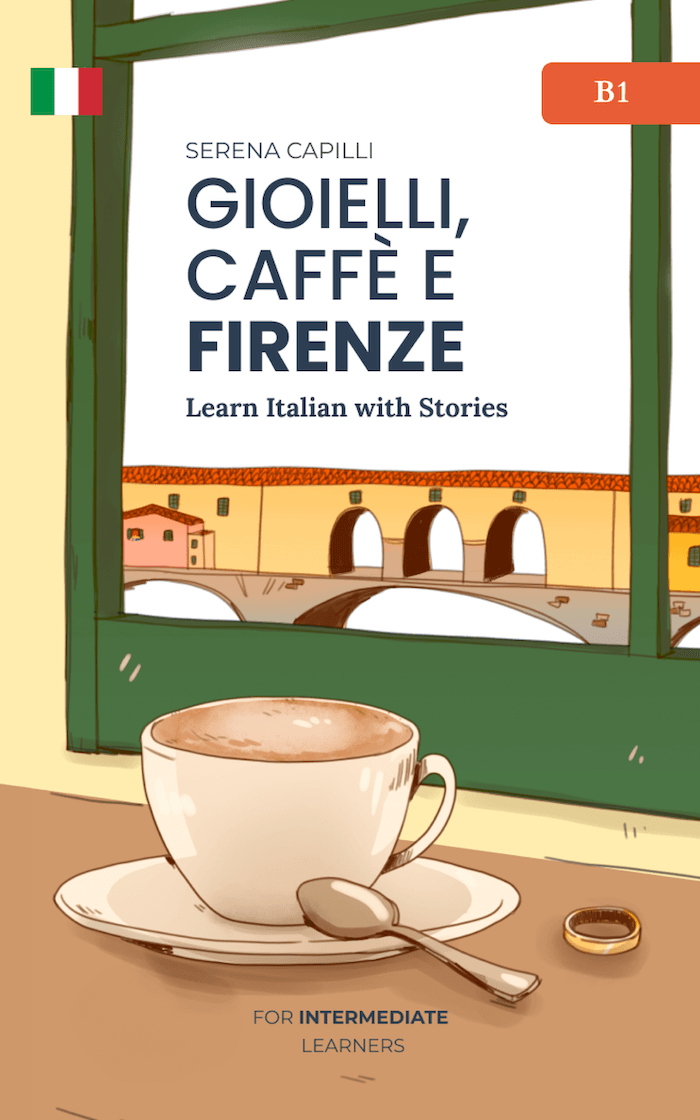
Gioielli, Caffè e Firenze
Level B1+
Marie moves to Florence, where jewelry making leads to a new life.

7 Romance Short Stories in Italian
Level B1/B2
Seven stories about love and everyday life, full of natural conversations.
Dive deeper: perché vs siccome · how to use cioè · anzi · the Italian present subjunctive