The PLIDA B1 is one of the four official Italian language certificates you can use to prove a B1 level of Italian, including for your Italian citizenship application. In this guide I explain how the exam works, how it is scored, what you need to know at B1, and how I suggest you prepare.
In short
- PLIDA = Progetto Lingua Italiana Dante Alighieri, issued by the Società Dante Alighieri.
- 4 tests: listening (about 40 min), reading (40 min), writing (60 min), speaking (about 15 min).
- Each test is scored out of 30: you need at least 18/30 in every test.
- Failed a test? You can retake only that part within 18 months.
- Remaining B1 session in 2026: 18 November. Check the official calendar for 2027.
What is the PLIDA exam?
PLIDA stands for Progetto Lingua Italiana Dante Alighieri. The certificate is issued by the Società Dante Alighieri, the institution that promotes the Italian language around the world, and it is recognized by the Italian Ministry of Foreign Affairs. Together with the CILS (Siena), the CELI (Perugia) and the CERT.IT (Roma Tre), it is one of the certificates accepted for Italian citizenship.
The PLIDA for adults is offered at levels A1, A2, B1, B2, C1 and C2, in more than 300 exam centers in over 60 countries.
Which level do you need for citizenship?
For citizenship by marriage or residency, you need a B1. With the PLIDA, you take the standard B1 exam. If you’re comparing options, read my guide to the CILS B1 Cittadinanza too.
The structure of the PLIDA B1 exam
| Test | Time | What you do |
|---|---|---|
| Ascoltare (listening) | about 40 min | 4 parts, 20 questions: you listen to dialogues, messages and announcements and answer multiple-choice or matching questions. |
| Leggere (reading) | 40 min | 4 parts, 18 questions on short texts such as articles, ads and emails. |
| Scrivere (writing) | 60 min | 2 texts: the first is 110 to 150 words. Always check the word count written in each prompt. |
| Parlare (speaking) | about 15 min | A short self-introduction (not graded), then an interaction (3 to 4 min) and a monologue (3 to 4 min), each with 3 minutes to prepare. |
How the PLIDA B1 is scored
- Each of the four tests is scored out of 30 points.
- To get the certificate, you need at least 18/30 in every test.
- In listening and reading, a wrong, missing or double answer is worth 0 points.
- Writing and speaking are marked with grids that look at content, coherence, vocabulary, grammar and, for speaking, pronunciation and interaction.
- If you fail one or more tests (up to three), you can retake only those within 18 months of your first registration.
PLIDA B1 dates and exam centers
In 2026 the PLIDA B1 was offered on 11 February, 10 June and 9 September, and the next session is on 18 November 2026. You register through an exam center, usually several weeks before the exam, so check deadlines with the center directly. The 2027 dates will be published on the official PLIDA website.
PLIDA centers are mostly Dante Alighieri committees, universities and language schools. In the US there are fewer PLIDA centers than CILS centers, so check what’s available near you before choosing your exam.
What does B1 mean?
B1 is the “threshold” level of the Common European Framework of Reference (CEFR). It’s the moment you stop surviving in Italian and start really communicating. At B1 you can:
| Skill | At B1 you can… |
|---|---|
| Listening | understand the main points of clear, standard speech on familiar topics, if people don’t speak too fast. |
| Reading | understand a simple article, blog post or email on everyday topics without technical language. |
| Writing | write a simple text or an email, formal or informal, about your experiences, plans and opinions. |
| Speaking | handle most everyday situations, describe experiences and give your opinion briefly on topics like work, health, the environment or lifestyle. |
B1 grammar topics
You need a solid A1 and A2 base, plus these B1 topics:
- articulated prepositions: dal, della, sulla
- direct and indirect pronouns: lo dico, gli dico
- the particles ci and ne: ci penso, ne parlo
- double pronouns: me lo, te lo, glielo
- passato prossimo vs imperfetto
- pronouns with the imperative and modal verbs: dimmelo, posso farlo
- formal and informal imperative
- future and present conditional
- the present subjunctive: penso che sia
- common connectors: anche se, perciò, siccome, quindi, poiché
How to prepare for the PLIDA B1
I always suggest splitting your preparation into two parts.
1. Reach a real B1 level. The exam certifies your Italian, so if you’re still at A2, work on the language first: with a school, a private teacher or a self-paced course, and with a lot of reading and listening.
2. Learn the exam format. Every certificate has its own structure. Knowing how the tasks work, how long you have and where to write your answers will save you stress on exam day. Work with official sample papers, which you’ll find on the PLIDA preparation page.
My tips for each test
- Listening: read the questions before the audio starts, so you know what to listen for.
- Reading: don’t translate every word. Look for the key information the question asks for.
- Writing: respect the word count and the task. Use simple, correct sentences and link them with connectors. My B1 writing guide has sample texts with corrections, and my post on formal and informal emails will help with the email task.
- Speaking: prepare your self-introduction and practice giving your opinion with secondo me, penso che, sono d’accordo. Use the 3 minutes of preparation to note a few key words, not full sentences.
PLIDA B1 vs CILS B1 Cittadinanza
| PLIDA B1 | CILS B1 Cittadinanza | |
|---|---|---|
| Issued by | Società Dante Alighieri | Università per Stranieri di Siena |
| Tests | listening, reading, writing, speaking | listening, reading, writing, speaking |
| Retaking failed parts | yes, within 18 months | no, you retake the whole exam |
| Valid for | citizenship, work, study | citizenship only |
In my experience as a teacher, the PLIDA B1 is accessible and well structured, and being able to retake only the part you failed is a real advantage. The CILS B1 Cittadinanza, on the other hand, is designed around everyday life in Italy and is offered more often. More tips in my strategies for the citizenship exam.
Frequently asked questions
What is the PLIDA B1?
It’s an official certificate of Italian at B1 level issued by the Società Dante Alighieri. It’s accepted for Italian citizenship and recognized for work and study.
How is the PLIDA B1 scored?
There are four tests (listening, reading, writing, speaking), each scored out of 30. You need at least 18/30 in every test to pass.
Can I retake only one part of the PLIDA?
Yes. If you fail up to three tests, you can retake only those within 18 months of your first registration.
When is the next PLIDA B1 exam?
The last 2026 session for B1 is on 18 November 2026. The 2027 calendar is published on the official PLIDA website.
Is the PLIDA B1 accepted for Italian citizenship?
Yes. PLIDA is one of the certificates accepted to prove B1 Italian for citizenship by marriage or residency, together with CILS, CELI and CERT.IT.
Practice with my stories
Reading is the most effective (and pleasant) way to reach and keep a B1 level: you meet the grammar in context and build vocabulary without noticing. These stories are written for intermediate learners, with audio:
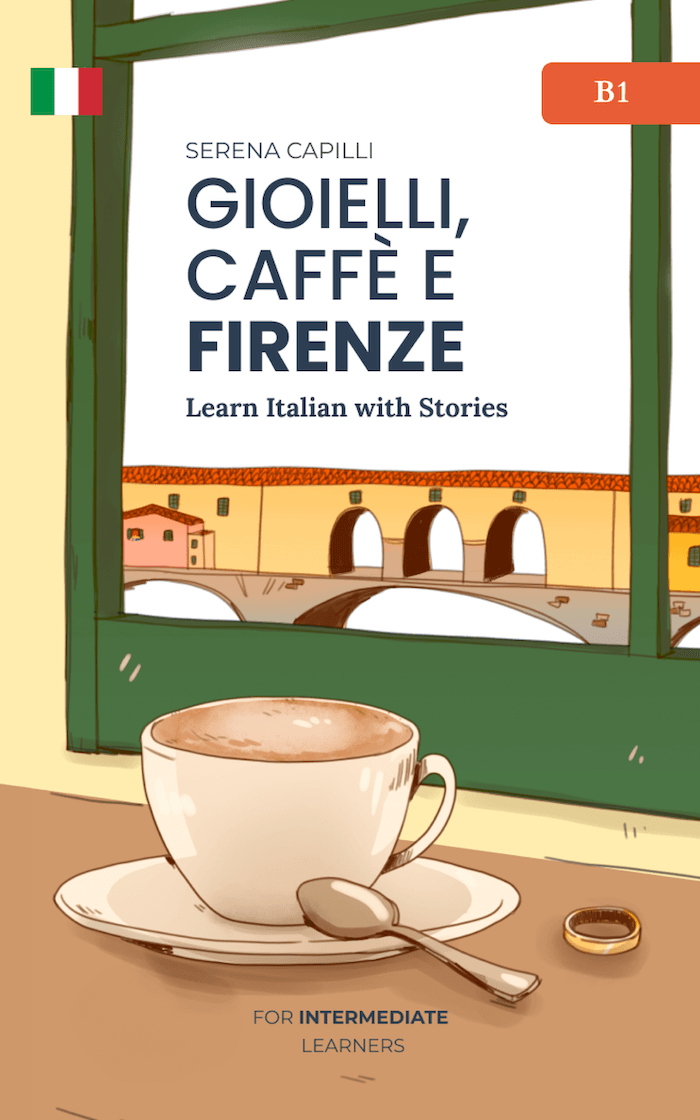
Gioielli, Caffè e Firenze
Level B1+
Marie moves to Florence, where jewelry making leads to a new life.

7 Romance Short Stories in Italian
Level B1/B2
Seven stories about love and everyday life, full of natural conversations.